
2026 Technical Update: if you want the broader exit-preparation framework first, start with the Complete Business Exit Strategy Checklist. This article stays with the financing side of the deal, because the way the purchase of a business will be structured still needs to be dealt with early, not after the letter of intent is already signed.
The simple fact has not changed. Financing the sale of a business is too important to treat as an afterthought. In Indiana, especially in the $1 million to $10 million market, the final structure of any sale is the product of negotiation between buyer and seller, lender requirements, tax consequences, and whatever reality shows up once the financial statements are tested. If the structure is weak, the headline price does not matter much. Weak structure is how deals stall, retrade, or die.
We see this in Fort Wayne and Indianapolis constantly. An owner gets an attractive number from a buyer, assumes the hard part is over, and then learns that the lender wants more equity, the seller note terms are too loose, working capital is underfunded, or the company will not comfortably service the debt stack being proposed. By that point the seller has already started counting money that is not yet real.
That is why sellers should answer six financing questions before serious negotiations begin. What is your lowest rock-bottom price? What are the tax consequences? What interest rate is acceptable if seller financing is involved? Have unsecured creditors been paid off? Will you cover part of the closing costs? Will the buyer assume long-term or secured debt, and can the business service all of that debt while still producing an acceptable return? Those were the right questions in the original article. They are still the right questions now. The difference is that today buyers, lenders, and quality-of-earnings reviewers are more disciplined about forcing specific answers.
Indiana is a strong place to sell a business, but buyers are not casual about underwriting. The SBA reported that Indiana small businesses received more than $493 million of 7(a) financing across 1,193 loans in fiscal year 2023, and statewide small businesses make up 99.4% of Indiana companies and employ about 1.2 million workers. There is capital in the market. There are buyers in the market. There is also scrutiny in the market. A Professional Valuation Assessment gives you a cleaner starting point because it forces the discussion onto documented cash flow and realistic structure instead of seller optimism.
What Is Your Rock-Bottom Price After Taxes and Terms?
Most sellers answer this question incorrectly because they answer it emotionally. They think about what they want, what they feel they deserve, or what another owner claimed to get. That is not the same thing as knowing the lowest number you will accept once taxes, working capital, seller paper, and risk are considered.
Your real rock-bottom number is not just a gross purchase price. It is your net, adjusted for structure. A $5.5 million offer with $4.6 million paid at closing, a $500,000 seller note, and a $400,000 earnout is not automatically better than a $5.1 million offer with $4.9 million at closing and a short transition. Owners who do not decide that ahead of time tend to negotiate against themselves.
Use a realistic Indiana example. Assume a Fort Wayne precision machining company receives two offers:
| Offer | Headline Price | Cash at Close | Seller Note / Earnout | What the Seller Really Has to Ask |
|---|---|---|---|---|
| Buyer A | $6,400,000 | $5,200,000 | $800,000 seller note and $400,000 earnout | How likely is full collection, and how much risk am I retaining? |
| Buyer B | $6,050,000 | $5,850,000 | $200,000 holdback only | Is the lower headline actually the stronger economic result? |
For many sellers, Buyer B is the better deal even though the sticker price is lower. The point is not that every seller should favor cash over price. The point is that you should decide where the trade line is before negotiations get personal.
This also connects directly to valuation methodology. If the buyer is underwriting on SDE and you are thinking in EBITDA terms, you may be negotiating with the wrong denominator before the financing discussion even begins. That is why owners should understand SDE vs EBITDA and which metric matters before they start arguing over a multiple.
Questions That Define a Real Minimum Number
- How much cash do you need at closing to retire debt, satisfy taxes, and fund your next move?
- How much seller financing are you willing to carry, and for how long?
- Will you accept a price premium in exchange for contingent payments?
- How much transition work are you willing to provide after close?
- What happens to your minimum number if the deal is structured as an asset sale instead of an equity sale?
Sellers who cannot answer those questions usually discover their true minimum price in the middle of negotiations. That is late. Late is expensive.
What Tax Consequences Matter Most for Indiana Sellers?
Sellers regularly spend more time negotiating the headline number than they spend modeling what they keep. That is backwards. The net is what matters.
As of 2026, Indiana’s individual adjusted gross income tax rate is 2.95%. County income tax sits on top of that and varies by county. In Allen County, for example, the local income tax rate is 1.59%. That means an Allen County owner can be looking at 4.54% in combined Indiana state and local tax before federal capital gains treatment, depreciation recapture, ordinary-income items, and any 3.8% net investment income tax are layered in.
Run the numbers on a $4 million taxable gain for an Allen County seller. Indiana state and local tax alone can be roughly $181,600. That is before federal tax. If part of the purchase price is allocated to equipment with depreciation recapture, consulting compensation, or a non-compete, the after-tax result can move materially.
That is why tax planning has to start before the LOI hardens the economics. Buyers in Indiana often prefer asset deals because they do not want hidden liabilities. Sellers often prefer an equity sale or at least a favorable purchase-price allocation. Lenders may also push the structure in one direction, especially in SBA-backed deals. If you wait until the purchase agreement stage to model taxes, you are negotiating from fatigue instead of clarity.
Where Indiana Sellers Usually Miss the Tax Issue
- They focus on enterprise value and ignore what debt payoff does to cash proceeds.
- They do not model asset sale versus stock sale outcomes before signing the LOI.
- They ignore county tax and only think in terms of federal tax.
- They treat earnouts and seller notes as price issues instead of tax-timing issues.
- They overlook how real estate held outside the operating company affects the structure.
An Indianapolis service company sold for $3.2 million may leave the seller with a very different net result than a $3.2 million northeast Indiana manufacturing deal because the allocation, basis, and debt payoff are different. Owners do not need to become tax lawyers. They do need to stop pretending structure is secondary.
How Interest Rates Change What a Buyer Can Actually Pay
Interest rates are no small matter. That sentence from the original post deserves more emphasis now because debt cost changes valuation in a direct way. Buyers do not buy a business with theory. They buy it with equity, debt, and a return threshold they can live with after closing.
Take a $4.8 million Indianapolis commercial services acquisition with $1.05 million of normalized EBITDA. If the buyer finances $3.8 million and debt service rises by even one to two points, the annual debt burden can move enough to change what price the lender and buyer will support. A business that looked comfortable at one rate can become tight at another if working capital, capex, or management replacement costs were underestimated.
| Illustrative Debt Structure | Debt Amount | Estimated Rate | Approximate Annual Debt Service | Why It Matters |
|---|---|---|---|---|
| SBA-backed senior debt | $3,600,000 | 11.0% | About $603,000 on a 10-year amortization | Still workable if the business has real cushion |
| SBA-backed senior debt | $3,600,000 | 12.0% | About $637,000 on a 10-year amortization | Another $34,000 of annual debt service reduces buyer flexibility |
| SBA debt plus seller note | $3,200,000 + $500,000 | 11.0% plus 7.0% | Depends on standby and amortization | Structure, not just rate, starts driving the decision |
That is why favorable terms can support a higher selling price. If a seller is willing to carry a note at a reasonable rate, or subordinate to senior debt on commercially sensible terms, the buyer may be able to justify a stronger headline number. The old brokerage point still holds: better terms often widen the buyer pool and improve price, because they make the capital stack work.
Why Unsecured Creditors, Closing Costs, and Assumed Debt Must Be Settled Early
Unsecured creditors, payoff letters, tax clearances, lease obligations, and transaction expenses sound like back-office details until closing week. Then they become deal issues.
If you plan to sell a company for $2.9 million and discover late that there is $240,000 of unsecured trade debt, a disputed tax liability, and a lender payoff higher than expected because of prepayment terms, your cash-to-close calculation changes immediately. Buyers hate late surprises. Lenders hate them even more.
Sellers also need to decide early whether they are paying part of the closing costs. In real transactions, that can include transfer taxes where applicable, broker fees, legal fees, accounting costs, escrow charges, valuation fees, or specific consents required to assign contracts or leases. If the seller assumes the buyer will handle all transaction friction, but the LOI says otherwise, the net gets thinner quickly.
Items Sellers Should Clear Before the Market Sees the Deal
- All payoff amounts on lines of credit, equipment notes, and secured debt
- Any overdue trade payables or disputed vendor balances
- Sales-tax, payroll-tax, or other unresolved tax issues
- Whether the buyer is assuming any long-term debt or whether all debt is being paid off at closing
- Who is paying which closing costs
- Whether working capital targets will leave enough liquidity in the business after closing
A South Bend industrial supplier priced at $4.3 million may look clean at first glance. Then diligence shows $310,000 of aged payables, a UCC filing tied to inventory finance, and a landlord consent fee. None of those issues has to kill the transaction. They do need to be identified before a buyer feels ambushed.
Will the Business Support Acquisition Debt and Still Produce a Buyer’s Return?
This may be the central financing question in the whole sale. Can the business service the proposed debt and still leave enough return for the buyer? If the answer is no, the price or structure has to change. There is no clever wording around that.
Indiana’s labor market is still tight. In December 2025, Indiana reported 83,797 open job postings, a 3.5% unemployment rate, and 63.6% labor-force participation. Buyers read those numbers through an operator’s lens. Tight labor means more pressure on wages, more risk around key employee retention, and less room for error if the seller is still personally carrying customer relationships or plant oversight.
Consider a Fort Wayne fabrication company offered at $6.1 million with $1.35 million of normalized EBITDA. On paper that looks reasonable. Then the buyer adds back three real-world adjustments:
- $160,000 to replace part of the owner’s management function
- $90,000 of expected wage pressure to retain key supervisors
- $75,000 of recurring capex that had been deferred
Now lender-supporting EBITDA is effectively closer to $1.025 million. The asking price may still be possible, but the capital stack is tighter. Debt service coverage shrinks. The buyer’s required equity goes up. The seller note becomes more important. This is why owners should read the buyer financing roadmap. It shows the process from the buyer’s side, which is useful because sellers often underestimate how disciplined the underwriting really is.
How SBA 7(a) Loans Work for Business Acquisitions
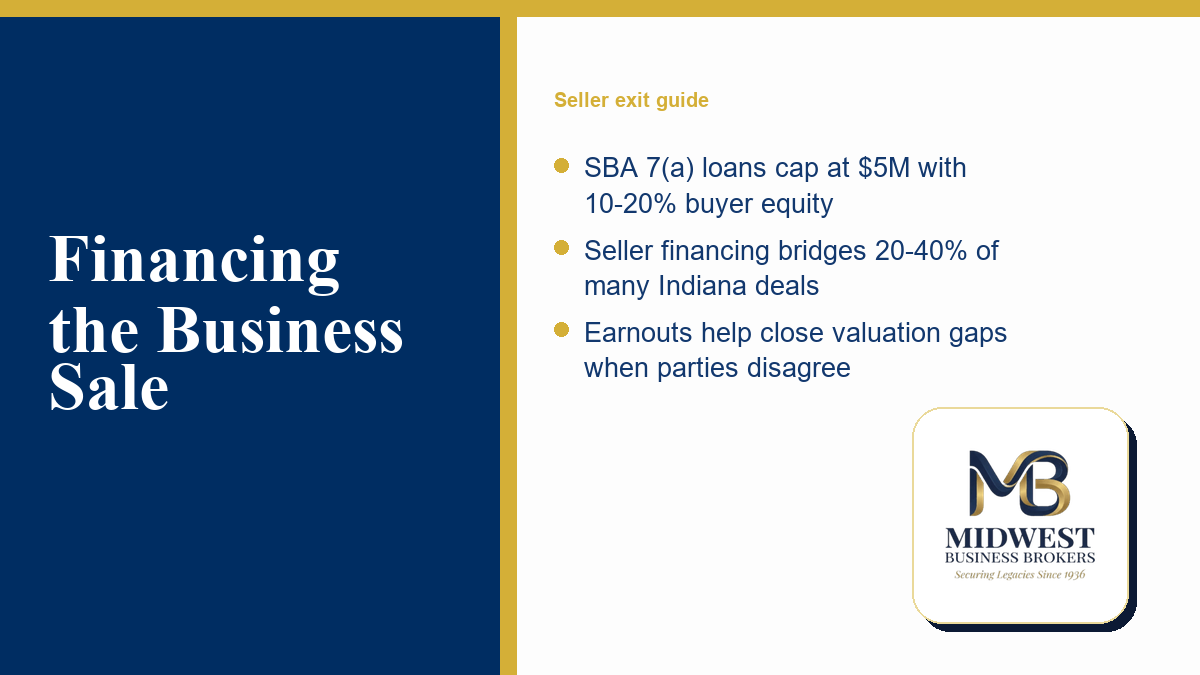
For many Indiana deals in the $2 million to $5 million band, SBA 7(a) financing is still the main acquisition tool. The SBA’s 7(a) program can be used for complete or partial changes of ownership, and the maximum 7(a) loan amount is $5 million. That matters because it creates both opportunity and a hard ceiling. Once a deal gets much above that level, the structure often has to include more buyer equity, more seller paper, conventional bank debt, or a different buyer entirely.
Owners hear “SBA loan” and assume that means easy money. It does not. It means standardized rules, lender discipline, guaranty support, and documentation. For complete changes of ownership above $500,000, SBA policy continues to matter heavily because a 10% equity injection is typically required. That requirement drives down-payment discussions from the very beginning.
Here is a realistic Indianapolis example. Assume a buyer wants to acquire a janitorial and facility-services business for $3.6 million.
| Capital Stack Item | Amount | Comment |
|---|---|---|
| Purchase price | $3,600,000 | Asset deal |
| Buyer equity injection | $360,000 | 10% minimum target |
| SBA-backed senior loan | $2,940,000 | Within program size limits |
| Seller note | $300,000 | May help bridge the gap if terms satisfy lender requirements |
That structure can work if cash flow is real, the buyer has post-close liquidity, and the transition risk is manageable. It can fail if working capital was understated, the owner is too central to revenue, or the buyer’s outside cash is already being consumed by fees and operating reserves.
What Sellers Should Expect in an SBA-Backed Deal
- A lender-supported business valuation if the transaction size requires it
- Detailed review of tax returns, interim financials, and seller add-backs
- Scrutiny of management continuity and owner dependence
- Review of the lease, landlord consent, and transferability of key contracts
- Evidence of the buyer’s cash injection and liquidity
- Tighter timing than many sellers expect, because lender underwriting and closing conditions take time
For Indiana sellers, the practical point is simple. SBA financing expands the buyer pool, especially for profitable companies below the upper middle market. It also introduces a lender into the center of the transaction. Sellers who understand that early can negotiate better and react less emotionally when the lender starts asking uncomfortable questions.
Seller Financing: When It Makes Sense and How to Structure It
Seller financing makes sense when it solves a real gap instead of disguising a bad deal. In practice, it is often used for one of three reasons. The lender will not finance the full price. The seller wants a stronger headline number. Or both parties want to show confidence by sharing some post-close risk.
A seller note can be a smart tool in Indiana’s lower middle market. It can also be sloppy if nobody defines the terms. Sellers should know the interest rate, amortization, maturity, payment timing, collateral position, standby requirements, default remedies, and whether there is any personal guaranty. “Seller financing available” is not a structure. It is a sentence.
Take a $5.4 million Fort Wayne distribution deal. The buyer can bring $700,000 in equity and the senior lender will support $4.0 million. That leaves a $700,000 gap. A seller note can bridge it, but only if the terms fit the business and the lender.
| Seller Note Term | Conservative Structure | Riskier Structure |
|---|---|---|
| Principal | $700,000 | $1,100,000 |
| Interest rate | 6% to 8% | Below-market with vague terms |
| Amortization | 5 years, with or without short standby | Balloon with no clear refinance path |
| Documentation | Promissory note, subordination, default rights | Handshake economics disguised as goodwill |
Seller financing is usually strongest when the seller is dealing with a quality buyer, the cash-at-close number still works, and the note amount is large enough to help but not so large that the seller becomes the lender of last resort. If the seller note is carrying the entire economics of the deal, the seller is no longer just selling a business. The seller is underwriting the buyer.
The Role of Earnouts in Bridging Valuation Gaps
Earnouts exist because buyers and sellers disagree about future performance. The seller believes the upside is real. The buyer believes the risk is real. An earnout turns that disagreement into a formula.
Used correctly, an earnout can bridge a valuation gap without destroying the deal. Used badly, it produces two years of arguments after closing.
Suppose an Indianapolis specialty contractor is being negotiated at between $4.7 million and $5.3 million. The buyer is comfortable paying $4.8 million at close based on current earnings. The seller insists that several municipal and commercial contracts already in the pipeline justify more value. One solution is a $500,000 earnout tied to a measurable threshold, such as gross profit from a defined contract list or EBITDA above a stated baseline during the first twelve months after closing.
The problem is that many earnouts are drafted too loosely. If the formula depends on post-close discretionary spending, management choices the seller does not control, or accounting definitions nobody spelled out, the earnout becomes a future lawsuit in nicer clothes.
Earnout Terms That Need to Be Explicit
- The exact metric: revenue, gross profit, EBITDA, or another stated measure
- The measurement period and who prepares the calculation
- What accounting rules apply
- Whether the buyer must operate the business in the ordinary course
- What information rights the seller receives
- When the earnout is paid and what happens in a dispute
For many Indiana sellers, a modest seller note is cleaner than an earnout. But when a real valuation gap exists and the upside can be measured cleanly, an earnout can keep both parties moving.
What Buyers Need to Qualify for Acquisition Financing
Sellers often ask whether a buyer is “qualified” and mean whether the buyer sounds serious. Lenders mean something different. Qualification means the buyer has enough cash, enough liquidity after closing, enough relevant experience or management support, enough credit quality, and a believable plan to run the company without breaking it.
That matters in Indiana because the buyer pool for $2 million to $7 million deals is mixed. You may be dealing with an individual search buyer, a first-time acquirer, a strategic operator, a private equity-backed add-on buyer, or a regional competitor. Each comes with a different financing profile.
- A first-time buyer may need stronger management continuity and more seller transition help.
- A strategic buyer may have deeper infrastructure but demand more aggressive diligence.
- A private equity-backed buyer may pay more but ask for tighter representations, a rollover, or an earnout.
- An SBA-backed individual buyer may be very viable, but only if liquidity and lender support are real rather than theoretical.
A lender looking at a $3.1 million acquisition in Lafayette is going to ask basic questions very quickly. How much cash is the buyer injecting? What will liquidity look like the day after closing? Has the buyer ever managed a team this size? Is the seller staying for a transition? Can the business still perform if one account manager leaves? Sellers should be asking similar questions before granting exclusivity.
How Down Payment Requirements Affect Deal Structure
Down payment requirements sound simple. They are not simple, because they determine who has leverage and whether the structure can close at all.
Under current SBA guidance, a complete change of ownership above $500,000 generally requires a 10% equity injection. On a $2.4 million acquisition, that may mean $240,000 from the buyer. On a $5.8 million acquisition, the math becomes more complicated because the senior SBA piece cannot exceed $5 million and the buyer still has to cover fees, working capital, and post-close liquidity.
Look at three common Indiana-style scenarios:
| Deal Size | Likely Financing Pressure Point | What Usually Fixes It |
|---|---|---|
| $2,200,000 HVAC company in Indianapolis | Buyer has enough equity but limited reserve cash | Moderate seller note or tighter working-capital planning |
| $4,600,000 Fort Wayne manufacturer | Debt service works only if add-backs are fully supported | Better earnings proof and realistic owner replacement cost |
| $6,700,000 logistics business near Indianapolis | SBA cap and buyer equity gap create a structural shortfall | More buyer equity, larger seller note, or different buyer type |
This is the point many sellers miss: down payment requirements do not just affect the buyer. They affect your price, your note risk, and how many qualified bidders you actually have. A seller asking top-of-market pricing while refusing any structure support may be limiting the buyer universe more than he realizes.
If you are preparing ahead of time, the best move is to line up your financial package early, tighten the add-backs, and use the Complete Business Exit Strategy Checklist to remove the issues that make lenders more conservative. Cleaner deals usually need less creative rescue work.
Why Financing Falls Through and How Indiana Brokers Prevent It
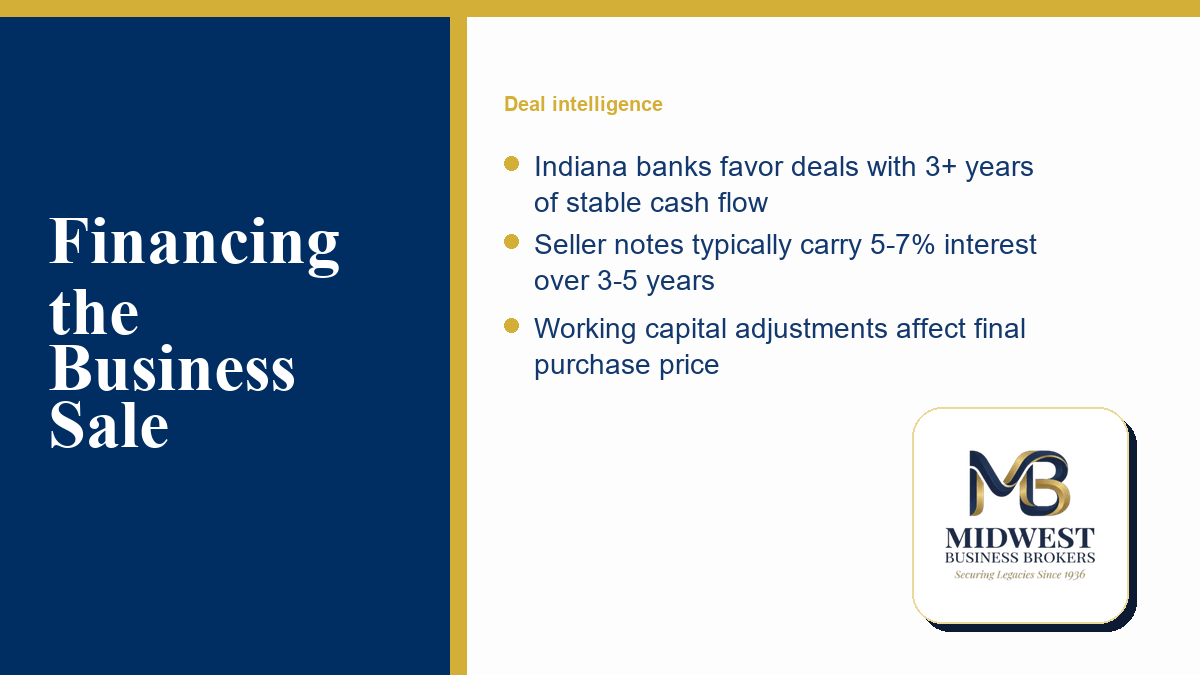
Financing usually falls through for predictable reasons. The cash flow was overstated. The buyer did not have enough real liquidity. The lender got uncomfortable with customer concentration, owner dependence, lease risk, or working capital. The seller note terms did not fit the senior debt. The parties waited too long to solve tax, payoff, or closing-cost issues. None of that is exotic.
Here is what most owners do not realize until it is too late: financing failure usually starts before the failure is visible. It starts when the seller goes to market with weak financial support, when the buyer claims funding before a lender has seen the exact deal, or when everyone assumes structure can be fixed later.
An experienced broker prevents that by pressure-testing the structure early. That means pushing on buyer qualification, documenting add-backs, modeling net proceeds, sizing seller financing realistically, and translating lender concerns before they become retrade language. It also means using local context. A buyer looking at an Indianapolis route-based service business faces different staffing and transition issues than a buyer looking at a Fort Wayne machine shop. A good process respects that instead of using generic deal templates.
A Financing Failure Checklist for Sellers
- Do not accept a financed offer without understanding the buyer’s actual cash injection.
- Do not assume the lender will underwrite your add-backs exactly as you present them.
- Do not wait until due diligence to uncover liens, tax issues, or payoff surprises.
- Do not carry a seller note without clear terms, subordination language, and default rights.
- Do not treat working capital as an afterthought in an asset sale.
- Do not confuse a higher price with a better deal if the structure puts too much collection risk back on you.
If you are selling in the next 12 to 24 months, financing preparation should be happening now, not when a lender is already dictating conditions. If you want a direct conversation about value, structure, buyer fit, and what your deal is likely to withstand in underwriting, Schedule Your Confidential Consultation.
Buyers working through financing, diligence, and transferability can continue with Midwest’s wholesale-business acquisition guide for the next related acquisition decision.
Frequently Asked Questions About Financing a Business Sale
Do most Indiana business sales include some seller financing?
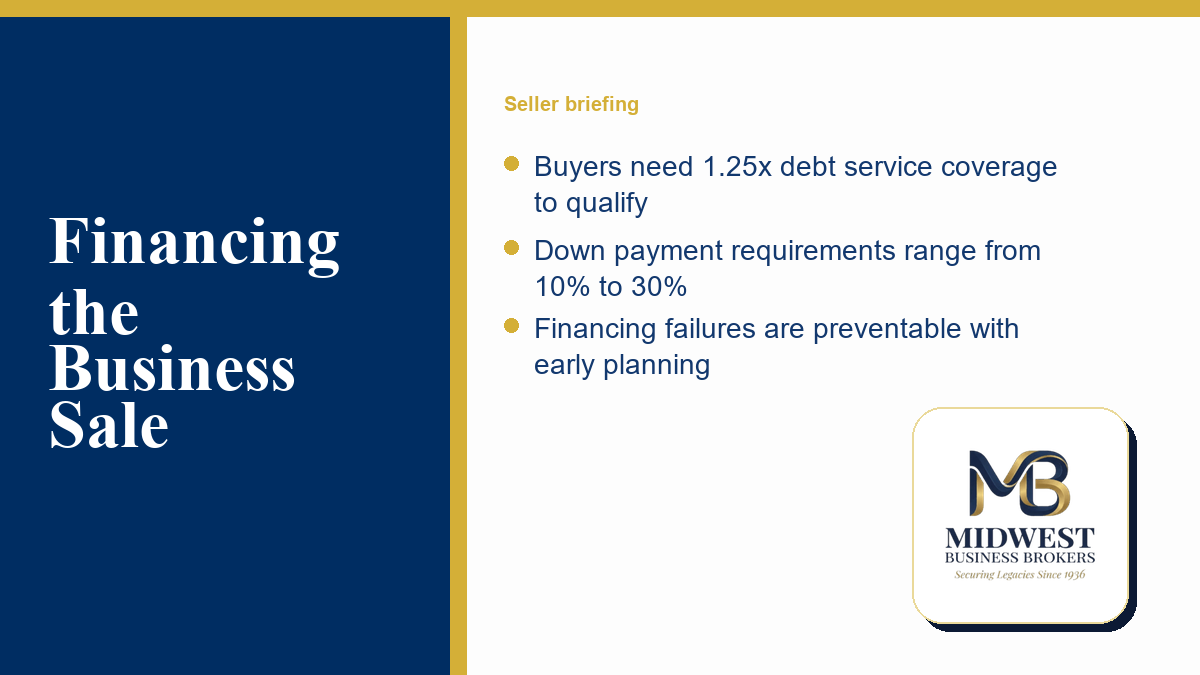
Many do, especially in the $2 million to $7 million range. A seller note is common when the buyer is using SBA or bank financing and the parties need to bridge a valuation gap or improve debt-service coverage.
How much down payment does a buyer usually need for an SBA-backed acquisition?
For a complete change of ownership above $500,000, a 10% equity injection is often the working assumption under current SBA rules. The exact structure still depends on lender underwriting, the buyer’s liquidity, and whether a seller note is involved.
Is a higher offer always better if part of the price is an earnout?
No. A higher headline number can be worse if too much of it is contingent, subordinated, or dependent on post-close results the seller no longer controls. Net certainty matters as much as gross price.
Can a buyer assume existing business debt instead of refinancing it?
Sometimes, but it depends on the lender, the debt documents, and whether the existing debt fits the buyer’s new capital structure. In many lower-middle-market asset sales, debt is paid off at closing rather than assumed.
Why do lenders reduce value even when revenue looks strong?
Lenders care about transferable cash flow, not just revenue. They will reduce support for the purchase price if the owner is too central, add-backs are weak, customer concentration is high, or post-close capex and working capital needs are understated.
When should a seller start planning the financing side of the deal?
Ideally 12 to 24 months before going to market. That gives you time to normalize earnings, pressure-test value, clean up debt issues, prepare for lender scrutiny, and negotiate from facts instead of fatigue.
Your Next Step as an Indiana Business Owner
If you are thinking about selling a company in the next one to three years, do not wait until a buyer’s lender tells you what your structure can and cannot support. Start earlier, get the numbers straight, and decide what terms you will actually accept before the market does that job for you. Schedule Your Confidential Consultation to talk through likely value, financing options, buyer qualification, and the structure that gives your deal the best chance of closing on terms you can live with.
 English
  Español de México
  简体中文
简体中文