
Business Exit Planning - Complete Business Exit Strategy Checklist
A 12-Month Roadmap to Selling Your Business for Maximum Value

Selling your business is likely the most significant financial transaction of your life. The difference between a well-planned exit and a rushed sale can be measured in hundreds of thousands—sometimes millions—of dollars.
After nearly 90 years of guiding business owners through successful exits, we've learned that preparation is the single greatest determinant of sale price and transaction success. Business owners who follow a structured exit planning process consistently achieve higher valuations, attract more qualified buyers, and close deals faster than those who decide to sell and immediately list their business.
This 12-month roadmap provides a comprehensive, month-by-month checklist to prepare your business for sale. While some owners may need more time (particularly if significant operational improvements are required), this timeline establishes the critical benchmarks for a successful exit.
Use this checklist whether you're planning to sell in the next year or simply want to understand what's involved. Even if your timeline extends beyond 12 months, starting this process now puts you in control of your exit—rather than reacting to circumstances that force a sale.
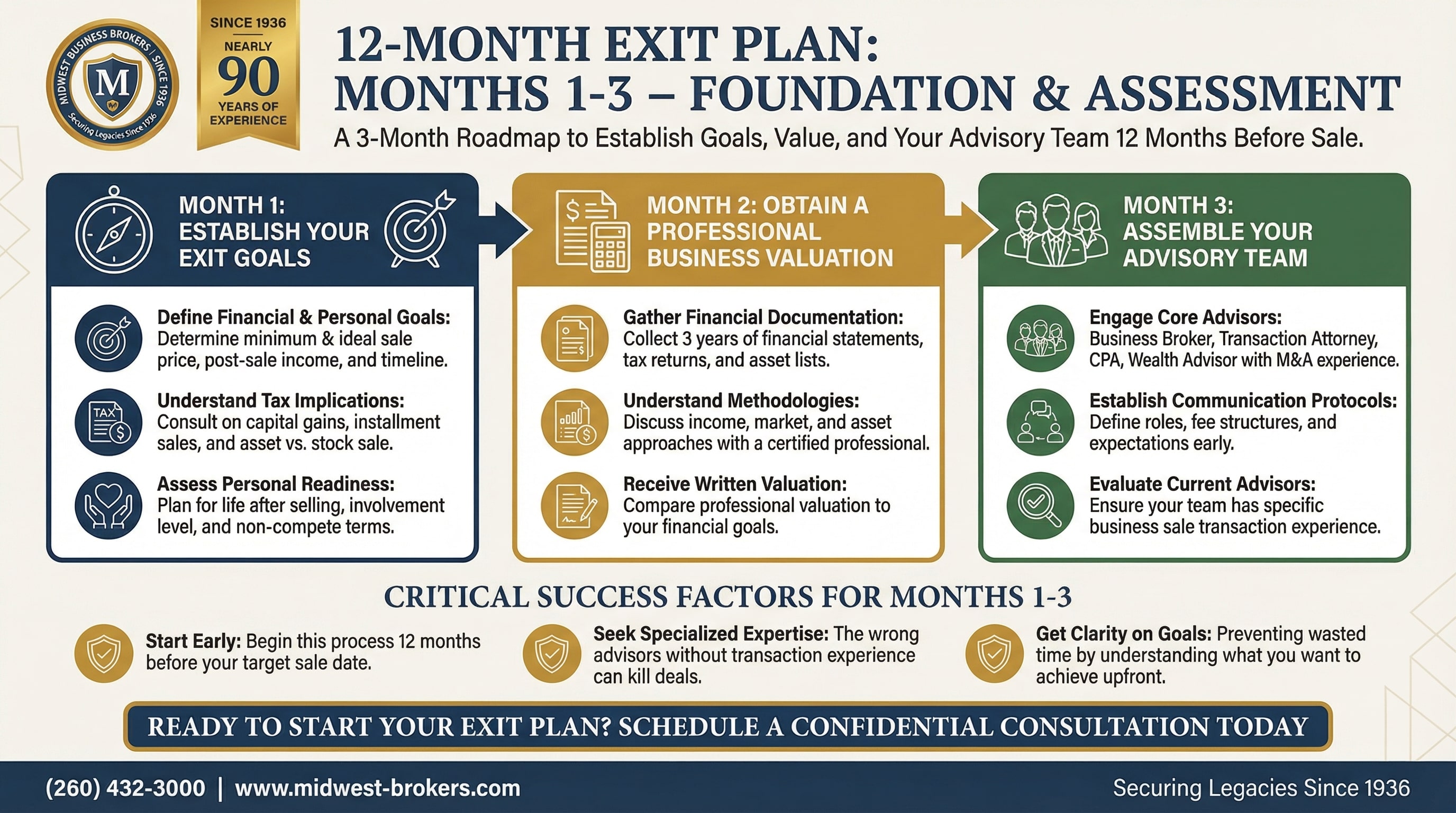
MONTHS 1-3: FOUNDATION & ASSESSMENT
Start here—12 months before your target sale date
Month 1: Establish Your Exit Goals
The first step in any exit plan is understanding what you want to achieve—both financially and personally.
Financial Goal Setting:
☐ Determine your minimum acceptable sale price (the floor you won't go below)
☐ Calculate your ideal sale price based on lifestyle and retirement goals
☐ Identify your post-sale income requirements (passive income, investment returns, etc.)
☐ Consult with a financial advisor about your overall wealth picture
☐ Understand the tax implications of a business sale (capital gains, installment sales, asset vs. stock sale)
☐ Review existing debt obligations that must be satisfied at closing
☐ Assess your personal readiness for life after selling
Personal Goal Clarification:
☐ Define your ideal timeline for exiting the business
☐ Determine your desired level of involvement post-sale (clean break vs. transition period)
☐ Consider non-compete agreement terms you'd be willing to accept
☐ Discuss exit plans with family members who may be affected
☐ Identify what you'll do after selling (retirement, new venture, consulting, travel)
Why This Matters: Business owners who skip this step often derail transactions midway through negotiations because they haven't thought through what they actually want. Clarity on your goals prevents wasted time for everyone involved.
Month 2: Obtain a Professional Business Valuation
Before making any decisions, you need to know what your business is actually worth in today's market—not what you hope it's worth or what you need it to be worth.
Valuation Preparation:
☐ Gather three years of complete financial statements (profit and loss, balance sheet)
☐ Collect three years of business tax returns
☐ Prepare a list of all tangible assets (equipment, vehicles, inventory, real estate)
☐ Document intangible assets (customer lists, proprietary processes, contracts, intellectual property)
☐ Compile a summary of owner compensation and benefits
☐ Identify add-backs and discretionary expenses that affect true earnings
☐ List any pending legal, tax, or compliance issues
Engage Professional Valuation:
☐ Schedule valuation consultation with a certified business intermediary
☐ Provide complete and accurate financial documentation
☐ Discuss different valuation methodologies (income approach, market approach, asset approach)
☐ Understand the multiples applicable to your industry
☐ Receive written valuation report with supporting analysis
☐ Compare valuation to your financial goals from Month 1
Month 3: Assemble Your Advisory Team
Selling a business requires specialized expertise across multiple disciplines. Attempting to manage this process alone—or with advisors who lack transaction experience—costs owners dearly.
Core Advisory Team:
☐ Business Broker/Intermediary: Engage a certified professional to manage the sale process
☐ Transaction Attorney: Retain legal counsel experienced in business sales (not just general practice)
☐ CPA/Tax Advisor: Consult with an accountant who understands M&A tax implications
☐ Financial/Wealth Advisor: Coordinate with your personal financial planner on post-sale planning
Advisory Team Coordination:
☐ Introduce all advisors to each other early in the process
☐ Establish clear communication protocols
☐ Define roles and responsibilities for each advisor
☐ Discuss fee structures and engagement terms
☐ Set expectations for response times during active negotiations
Evaluate Your Current Advisors:
☐ Does your current CPA have business sale experience?
☐ Has your attorney handled business transactions (not just formation and contracts)?
☐ Will your advisors work collaboratively, or do they operate in silos?
☐ Are there any conflicts of interest to address?
Why This Matters: The wrong advisors—or advisors who don't communicate—kill deals. We've seen transactions collapse because an attorney unfamiliar with business sales inserted unreasonable terms, or a CPA failed to structure the deal tax-efficiently. Your advisory team should function as an integrated unit with transaction experience.
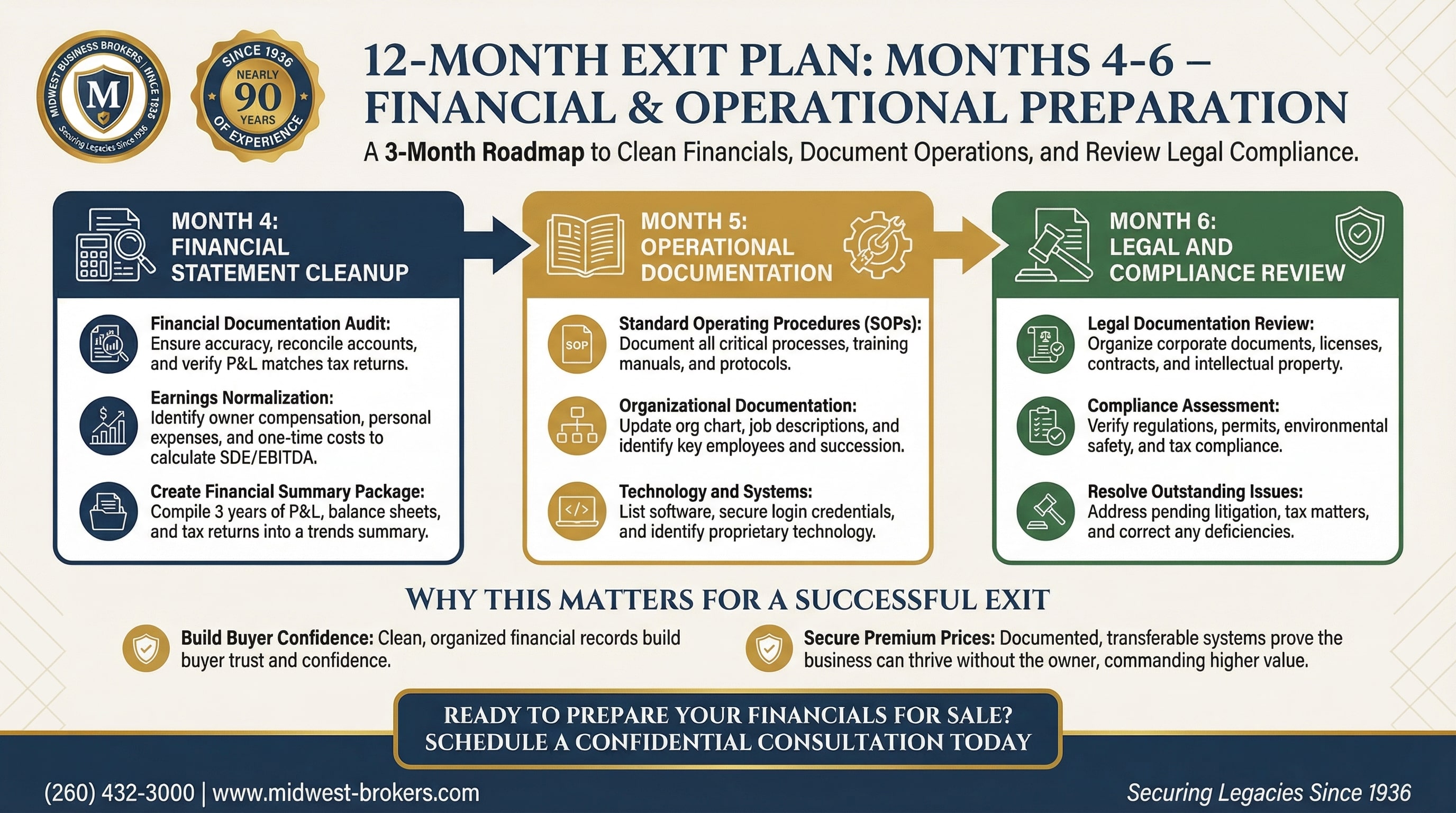
MONTHS 4-6: FINANCIAL PREPARATION
Month 4: Financial Statement Cleanup
Buyers and their lenders will scrutinize your financials extensively. Clean, consistent, well-organized financial records build buyer confidence—and sloppy books destroy it.
Financial Documentation Audit:
☐ Ensure all financial statements are accurate and up-to-date
☐ Reconcile bank statements with accounting records
☐ Verify that P&L statements match tax returns (explain any discrepancies)
☐ Confirm all revenue and expenses are properly categorized
☐ Review accounts receivable aging—collect overdue amounts where possible
☐ Assess accounts payable and current obligations
☐ Document any loans, lines of credit, or debt obligations
Earnings Normalization:
☐ Identify owner salary and benefits for add-back calculation
☐ Document personal expenses run through the business
☐ List one-time or non-recurring expenses (lawsuit settlements, unusual repairs, etc.)
☐ Identify any below-market or above-market expenses (family member salaries, sweetheart deals)
☐ Calculate adjusted EBITDA or Seller's Discretionary Earnings (SDE)
☐ Prepare add-back documentation with supporting evidence
Create Financial Summary Package:
☐ Compile three years of monthly P&L statements
☐ Prepare three years of annual balance sheets
☐ Gather three years of business tax returns
☐ Create summary spreadsheet showing trends and key metrics
☐ Document any significant variances year-over-year
Month 5: Operational Documentation
A business that depends entirely on the owner's knowledge and relationships is worth significantly less than one with documented, transferable systems.
Standard Operating Procedures (SOPs):
☐ Document all critical business processes
☐ Create step-by-step procedures for daily operations
☐ Write training manuals for key positions
☐ Record vendor ordering processes and supplier contacts
☐ Document customer service procedures and protocols
☐ Outline sales and marketing processes
☐ Detail financial and bookkeeping procedures
Organizational Documentation:
☐ Create or update organizational chart
☐ Document job descriptions for all positions
☐ List key employees with tenure, compensation, and responsibilities
☐ Identify any employees critical to business continuity
☐ Assess cross-training status (can others cover key functions?)
☐ Document management succession if you're not present
Technology and Systems:
☐ List all software and technology systems used
☐ Document login credentials (stored securely for transition)
☐ Identify any proprietary technology or custom solutions
☐ Assess technology upgrade needs
☐ Document website, social media, and digital asset access
Why This Matters: Buyers pay premium prices for businesses that can operate without the owner. If all the critical knowledge exists only in your head, you've built a job—not a sellable business. Documentation proves the business can thrive under new ownership.
Month 6: Legal and Compliance Review
Unresolved legal issues and compliance gaps derail transactions or significantly reduce sale prices. Address these proactively.
Legal Documentation Review:
☐ Locate and organize all corporate formation documents
☐ Gather all business licenses and permits
☐ Compile all active contracts (customer, vendor, supplier)
☐ Review lease agreements for assignment provisions
☐ Examine employment agreements and any non-compete clauses
☐ Locate all intellectual property documentation (trademarks, patents, copyrights)
☐ Review insurance policies and coverage adequacy
Compliance Assessment:
☐ Verify all licenses and permits are current
☐ Confirm compliance with industry-specific regulations
☐ Review environmental compliance (if applicable)
☐ Assess OSHA and workplace safety compliance
☐ Verify proper employee classification (W-2 vs. 1099)
☐ Confirm proper sales tax collection and remittance
☐ Review any pending or potential legal issues
Lease and Property Matters:
☐ Review lease terms and expiration dates
☐ Determine landlord's requirements for lease assignment
☐ Assess whether lease terms are favorable to a buyer
☐ Consider lease renewal or extension before sale if necessary
☐ If you own the real estate, decide whether to include or lease to buyer
Resolve Outstanding Issues:
☐ Address any pending litigation or disputes
☐ Resolve outstanding tax matters with IRS or state agencies
☐ Correct any compliance deficiencies identified
☐ Document resolution of any past issues
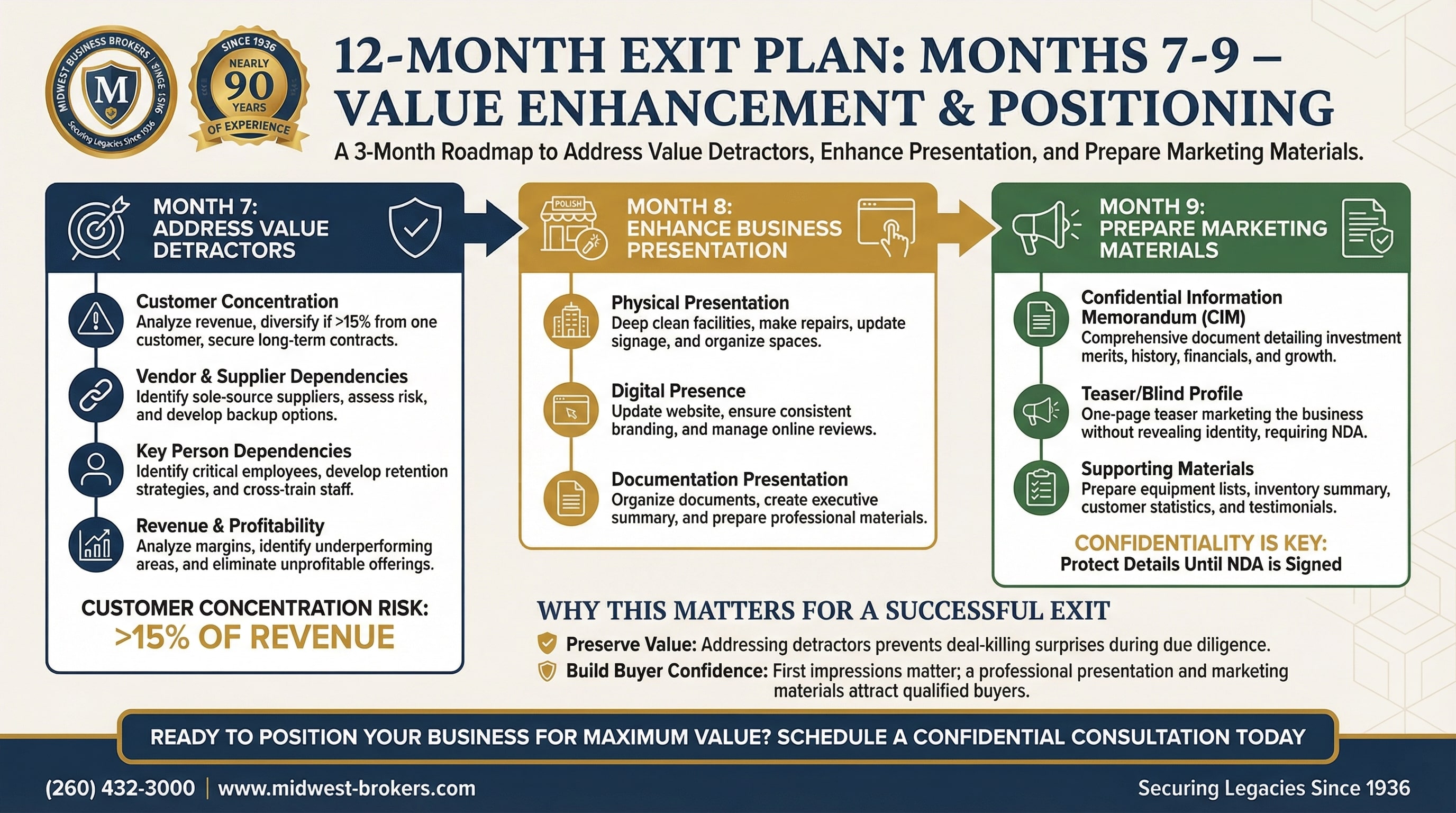
MONTHS 7-9: VALUE ENHANCEMENT & POSITIONING
Month 7: Address Value Detractors
Every business has weaknesses that reduce value in buyers' eyes. Identifying and addressing these now—rather than during due diligence—preserves value and prevents deal-killing surprises.
Customer Concentration:
☐ Analyze revenue by customer (identify concentration risks)
☐ If any customer represents >15% of revenue, develop diversification strategy
☐ Document customer retention rates and trends
☐ Secure long-term contracts with key customers where possible
☐ Develop new customer acquisition strategies
Vendor and Supplier Dependencies:
☐ Identify any sole-source suppliers
☐ Assess risk of supplier concentration
☐ Document supplier relationships and terms
☐ Develop backup supplier relationships where appropriate
Key Person Dependencies:
☐ Identify employees whose departure would significantly impact operations
☐ Develop retention strategies for key personnel
☐ Cross-train employees to reduce single points of failure
☐ Consider employment agreements or retention bonuses for key staff
☐ Assess your own involvement—can the business run without you?
Revenue and Profitability:
☐ Analyze profit margins by product/service line
☐ Identify underperforming areas and develop improvement plans
☐ Review pricing strategy and adjust if warranted
☐ Eliminate unprofitable offerings that distract from core business
☐ Focus on activities that demonstrate growth potential
Month 8: Enhance Business Presentation
First impressions matter. Buyers form opinions quickly based on what they see—both physically and on paper.
Physical Presentation:
☐ Deep clean facilities and equipment
☐ Make necessary repairs (deferred maintenance signals neglect)
☐ Update signage and branding where appropriate
☐ Organize storage areas and back-of-house spaces
☐ Address any safety hazards or code violations
☐ Consider modest cosmetic improvements with high ROI
Digital Presence:
☐ Update website with current information
☐ Ensure consistent branding across all platforms
☐ Review and respond to online reviews
☐ Update Google Business Profile and directory listings
☐ Clean up social media accounts
Documentation Presentation:
☐ Organize all documents in logical, accessible format
☐ Create executive summary of business operations
☐ Prepare professional-quality presentation materials
☐ Ensure all documents are current and accurate
☐ Develop answers to anticipated buyer questions
Month 9: Prepare Marketing Materials
Professional marketing materials—prepared with your business intermediary—present your business in the best possible light while maintaining confidentiality.
Confidential Information Memorandum (CIM):
☐ Work with broker to prepare comprehensive CIM
☐ Include executive summary highlighting key investment merits
☐ Detail business history and evolution
☐ Present financial performance with trends
☐ Describe operations, facilities, and equipment
☐ Outline growth opportunities for new owners
☐ Include market and competitive analysis
☐ Explain reason for sale (present honestly and positively)
Teaser/Blind Profile:
☐ Develop one-page teaser that markets business without revealing identity
☐ Include enough information to attract qualified buyers
☐ Protect confidential details until NDA is signed
Supporting Materials:
☐ Prepare equipment list with estimated values
☐ Create inventory summary
☐ Compile customer and market statistics (anonymized if needed)
☐ Gather testimonials or case studies demonstrating success
☐ Document competitive advantages and barriers to entry
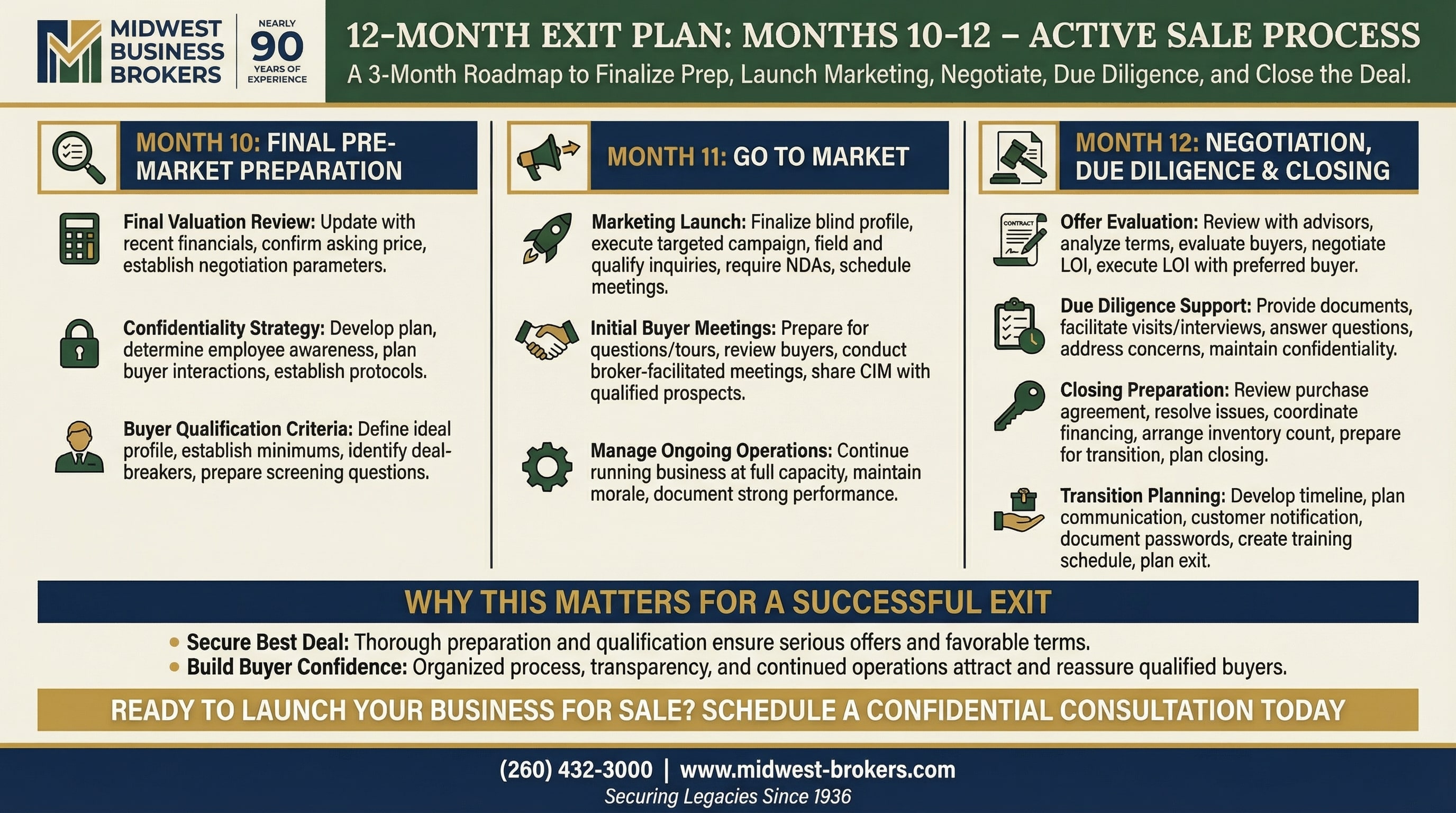
MONTHS 10-12: ACTIVE SALE PROCESS
Final stretch—deal closes at the end of Month 12
Month 10: Final Pre-Market Preparation
Before going to market, conduct a final review to ensure everything is in order.
Final Valuation Review:
☐ Update valuation with most recent financial performance
☐ Confirm asking price range with broker
☐ Establish negotiation parameters (walk-away points, flexibility areas)
☐ Discuss deal structure preferences (asset sale vs. stock sale)
☐ Determine seller financing willingness and terms
Confidentiality Strategy:
☐ Develop plan for maintaining confidentiality during sale process
☐ Determine which employees (if any) will be informed
☐ Plan for handling buyer visits and due diligence
☐ Establish protocols for information sharing
☐ Prepare responses if confidentiality is breached
Buyer Qualification Criteria:
☐ Define ideal buyer profile (financial capacity, industry experience, management ability)
☐ Establish minimum financial requirements
☐ Determine industry experience preferences
☐ Identify deal-breaker characteristics
☐ Prepare buyer screening questions
Month 11: Go to Market
With preparation complete, your business intermediary will begin marketing your business to qualified buyers.
Marketing Launch:
☐ Finalize and distribute blind profile to qualified buyers
☐ Execute targeted marketing campaign
☐ Field initial buyer inquiries through broker
☐ Qualify interested parties before sharing confidential information
☐ Require signed NDAs before releasing CIM
☐ Schedule preliminary meetings with qualified prospects
Initial Buyer Meetings:
☐ Prepare for buyer questions and facility tours
☐ Review qualified buyers with your broker
☐ Conduct initial meetings (broker-facilitated)
☐ Share CIM with serious, qualified prospects
☐ Answer questions honestly and thoroughly
☐ Maintain normal business operations throughout
Manage Ongoing Operations:
☐ Continue running business at full capacity
☐ Don't neglect customer service or sales efforts
☐ Maintain employee morale and productivity
☐ Document continued strong performance
☐ Address any emerging issues immediately
Month 12: Negotiation, Due Diligence & Closing
The final month involves intensive negotiation, detailed due diligence, and transaction closing.
Offer Evaluation:
☐ Review all offers with advisory team
☐ Analyze offer terms beyond just price (structure, contingencies, timeline)
☐ Evaluate buyer qualifications and financing capacity
☐ Consider seller financing requests carefully
☐ Negotiate letter of intent (LOI) terms
☐ Execute LOI with preferred buyer
Due Diligence Support:
☐ Provide requested documents promptly and completely
☐ Facilitate site visits and inspections
☐ Make key employees available for interviews (if appropriate)
☐ Answer all buyer questions honestly
☐ Address concerns as they arise
☐ Maintain confidentiality throughout process
Closing Preparation:
☐ Review purchase agreement with transaction attorney
☐ Negotiate final terms and resolve open issues
☐ Coordinate with buyer's lender for financing approval
☐ Arrange for inventory count and asset verification
☐ Prepare for transition training requirements
☐ Plan closing logistics and fund transfers
Transition Planning:
☐ Develop transition timeline with buyer
☐ Plan employee communication and introduction
☐ Prepare customer notification strategy
☐ Document all passwords, accounts, and access credentials
☐ Create training schedule for new owner
☐ Plan your own exit and handoff
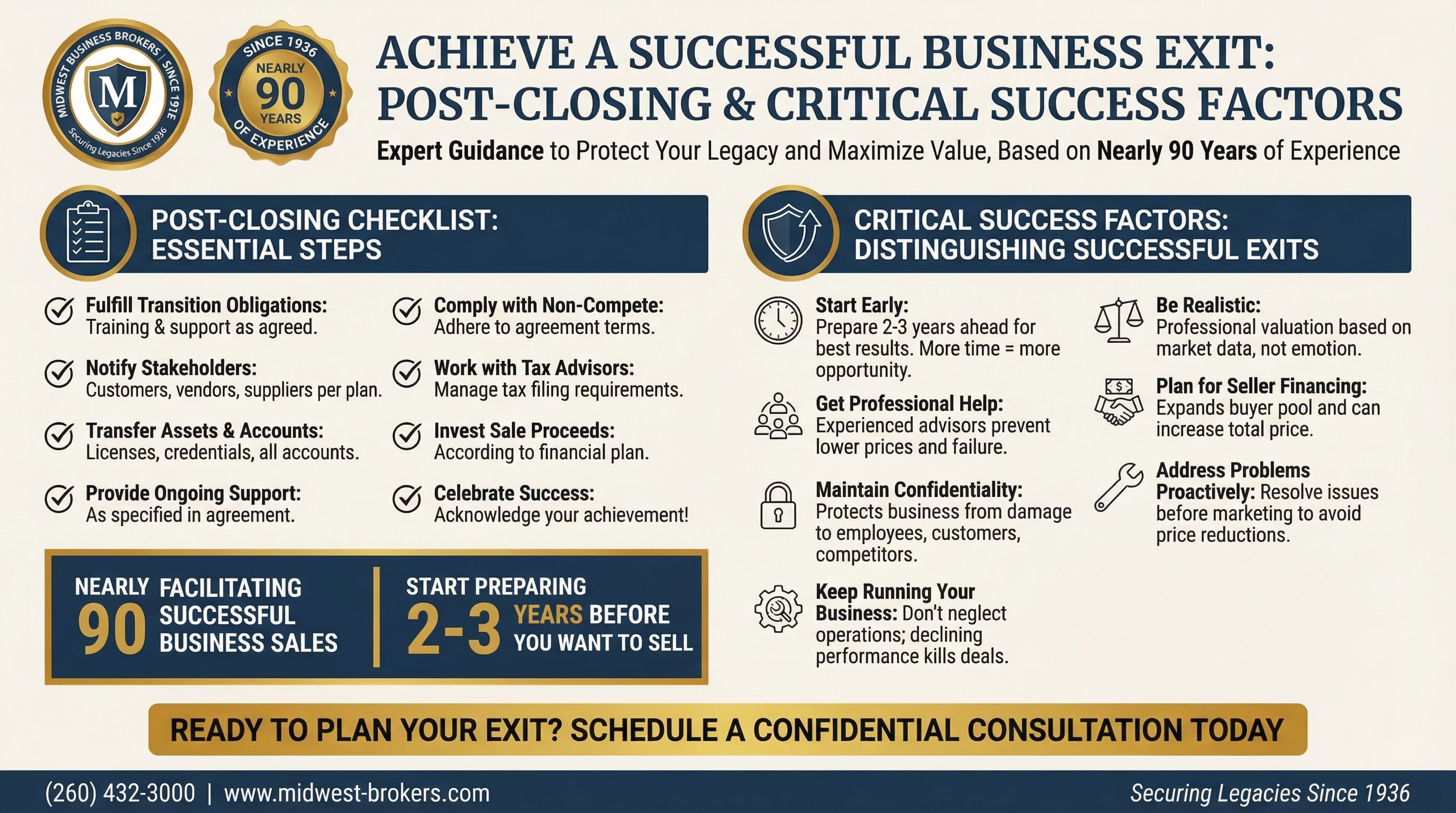
POST-CLOSING CHECKLIST
Even after closing, there are important steps to complete:
☐ Fulfill any training or transition obligations
☐ Notify customers, vendors, and suppliers per agreed plan
☐ Transfer all accounts, licenses, and credentials
☐ Provide ongoing support as specified in agreement
☐ Comply with non-compete agreement terms
☐ Work with advisors on tax filing requirements
☐ Invest sale proceeds according to financial plan
☐ Celebrate your successful exit!
CRITICAL SUCCESS FACTORS
After nearly 90 years of facilitating successful business sales, we've identified the factors that consistently distinguish successful exits from disappointing ones:
Start Early The owners who achieve the best results begin preparing 2-3 years before they want to sell. Even if you follow this 12-month roadmap, more time means more opportunity to enhance value.
Get Professional Help Attempting to sell your business without experienced advisors—particularly a certified business intermediary—consistently results in lower sale prices, longer timelines, and higher failure rates.
Maintain Confidentiality Premature disclosure of a pending sale damages businesses. Key employees leave, customers worry, competitors take advantage. Professional brokers know how to market your business while protecting your confidentiality.
Keep Running Your Business The most common mistake owners make is neglecting operations during the sale process. A declining business during due diligence kills deals or reduces prices. Stay focused on performance until closing day.
Be Realistic Emotional attachment often leads owners to overvalue their businesses. Professional valuations based on market data—not wishful thinking—set appropriate expectations and prevent wasted time.
Plan for Seller Financing Most small and mid-size business sales involve some seller financing. Owners who refuse to consider it dramatically limit their buyer pool and often receive lower total prices.
Address Problems Before Marketing Issues discovered during buyer due diligence create leverage for price reductions or deal termination. Identify and resolve problems proactively.
WHEN YOU'RE READY TO BEGIN
Whether you're planning to sell in 12 months or 5 years, the best time to start preparing is now.
Schedule a confidential consultation to discuss your situation, timeline, and goals. We'll provide an honest assessment of your business's current market value and the specific steps you should prioritize.
Our team of certified business intermediaries has guided business owners through successful exits since 1936. We understand that selling your business is about more than just a transaction—it's about protecting the value you've built, achieving your financial goals, and ensuring a smooth transition.
 English
  Español de México
  简体中文
简体中文