
Complete Business Valuation Guide
A Deep Dive into Business Valuation Methods

What is your business worth? It's a simple question with a complicated answer.
Business valuation is both art and science. While formulas and methodologies provide structure, the ultimate value of any business is determined by what a qualified buyer will actually pay in a competitive market.
After nearly 90 years of valuing and selling businesses, we've learned that most business owners significantly overestimate or underestimate their company's worth. Emotional attachment, years of hard work, and "what I need to retire" thinking often cloud judgment. Conversely, some owners undervalue businesses that have tremendous market appeal.
This guide provides a comprehensive overview of business valuation methods, helping you understand how professionals determine what businesses are worth—and what drives value up or down in the eyes of buyers.
Whether you're planning to sell soon, considering your options, or simply curious about your business's market value, this guide will give you the knowledge to make informed decisions.
PART 1: UNDERSTANDING BUSINESS VALUE
What Is Business Valuation?
Business valuation is the process of determining the economic value of a business or ownership interest. A professional valuation analyzes financial performance, assets, market conditions, industry factors, and qualitative characteristics to arrive at a defensible estimate of value.
Business valuations serve multiple purposes:
- Sale or Acquisition: Establishing fair market value for transaction negotiations
- Partner Buyouts: Determining value when one partner exits
- Divorce Proceedings: Dividing marital assets that include business interests
- Estate Planning: Establishing value for gift and estate tax purposes
- Litigation: Supporting damages claims or dispute resolution
- Financing: Demonstrating value to secure business loans
- Strategic Planning: Understanding current position and growth opportunities
The valuation purpose affects methodology. A valuation for estate tax purposes may differ from one prepared for a sale transaction, even for the same business. This guide focuses primarily on valuations for business sale purposes.
Fair Market Value: The Standard Definition
The most commonly used standard of value is Fair Market Value (FMV), defined as:
"The price at which property would change hands between a willing buyer and a willing seller, neither being under any compulsion to buy or sell, and both having reasonable knowledge of relevant facts."
This definition—used by the IRS, courts, and most business appraisers—contains critical elements:
Willing Buyer and Willing Seller: Neither party is forced to transact. A distressed seller or desperate buyer creates conditions outside fair market value.
No Compulsion: Both parties act in their own self-interest without pressure. Health emergencies, partnership disputes, or financial distress that force sales typically result in below-market transactions.
Reasonable Knowledge: Both parties understand the business, industry, and market conditions. Information asymmetry—where one party knows significantly more than the other—affects transaction outcomes.
Important Distinction: Fair market value represents what a hypothetical buyer would pay, not necessarily what a specific strategic buyer might pay. Strategic buyers sometimes pay premiums above fair market value for synergies, competitive elimination, or other strategic benefits.
Key Value Drivers
Before exploring specific methodologies, understanding what drives business value helps you interpret any valuation result.
Financial Performance Drivers:
- Revenue Size and Trends: Growing revenue commands premium multiples; declining revenue discounts value
- Profitability: Higher margins indicate pricing power and operational efficiency
- Cash Flow Consistency: Predictable cash flow reduces buyer risk
- Revenue Quality: Recurring revenue is worth more than one-time transactions
- Working Capital Requirements: Lower capital requirements increase attractiveness
Operational Drivers:
- Owner Dependence: Businesses that run without the owner are worth more
- Customer Concentration: Diversified customer bases reduce risk
- Employee Stability: Trained, loyal employees transfer value to buyers
- Systems and Processes: Documented operations demonstrate transferability
- Competitive Position: Market leadership and barriers to entry increase value
Market Drivers:
- Industry Trends: Growing industries command higher multiples
- Economic Conditions: Interest rates, lending availability, and economic outlook affect buyer capacity
- Buyer Demand: More buyers competing for businesses increases prices
- Comparable Transactions: Recent sales in your industry establish market expectations
Risk Factors That Reduce Value:
- Customer concentration (one customer = significant revenue)
- Key employee dependence
- Aging equipment requiring capital investment
- Lease uncertainty or unfavorable terms
- Pending litigation or compliance issues
- Declining revenue trends
- Industry disruption threats

PART 2: THE THREE VALUATION APPROACHES
Professional business appraisers use three fundamental approaches to value businesses. Most valuations consider multiple approaches and reconcile the results.
Approach 1: Income Approach
The income approach values a business based on its ability to generate economic benefits for its owners. This is the most common approach for valuing operating businesses with established earnings.
Core Principle: A business is worth the present value of its expected future economic benefits.
Two Primary Methods:
Method 1A: Capitalization of Earnings
This method converts a single period of economic benefit into value by applying a capitalization rate (or its inverse, a multiple).
The Formula:
Example:
- Business generates $300,000 in Seller's Discretionary Earnings (SDE)
- Industry multiple is 2.5x SDE
- Business Value = $300,000 × 2.5 = $750,000
Choosing the Right Earnings Measure:
Different earnings measures serve different purposes:
Seller's Discretionary Earnings (SDE): Most common for small businesses (under $1 million in earnings). SDE represents the total financial benefit available to a single owner-operator.
SDE = Net Income + Owner's Salary + Owner's Benefits + Interest + Depreciation + One-Time/Non-Recurring Expenses + Other Add-Backs
EBITDA (Earnings Before Interest, Taxes, Depreciation, and Amortization): Standard for larger businesses and private equity transactions. EBITDA assumes professional management will replace the owner.
EBITDA = Net Income + Interest + Taxes + Depreciation + Amortization
Adjusted EBITDA: EBITDA with additional adjustments for non-recurring items, above/below market expenses, and normalization adjustments.
Determining the Multiple:
Multiples vary significantly based on:
- Industry category
- Business size (larger businesses command higher multiples)
- Growth trajectory
- Risk profile
- Market conditions
- Quality of earnings
Typical Multiple Ranges by Business Type:
| Business Category | Typical SDE Multiple |
|---|---|
| Small retail/service businesses | 1.5x - 2.5x |
| Restaurants and food service | 1.5x - 3.0x |
| Professional services | 2.0x - 3.5x |
| Manufacturing | 2.5x - 4.5x |
| Distribution/wholesale | 2.0x - 4.0x |
| Technology/software | 3.0x - 6.0x+ |
| Healthcare services | 3.0x - 5.0x |
| Construction/trades | 1.5x - 3.0x |
Important: These ranges are general guidelines. Specific businesses may fall outside these ranges based on individual characteristics. Professional valuation considers the specific factors affecting your business.
Method 1B: Discounted Cash Flow (DCF)
DCF analysis projects future cash flows and discounts them to present value using a required rate of return. This method is more complex but captures growth expectations and risk explicitly.
The Concept:
A dollar received in the future is worth less than a dollar today. DCF analysis:
- Projects expected cash flows for a defined period (typically 5-10 years)
- Estimates a terminal value at the end of the projection period
- Discounts all future cash flows to present value using an appropriate discount rate
The Formula:
Business Value = Σ (Cash Flow_t ÷ (1 + r)^t) + Terminal Value ÷ (1 + r)^n
Where:
- Cash Flow_t = Expected cash flow in year t
- r = Discount rate (required rate of return)
- n = Number of projection years
- Terminal Value = Value of cash flows beyond the projection period
When DCF Is Most Appropriate:
- Businesses with significant expected growth
- Businesses with irregular or changing cash flow patterns
- Larger transactions where sophisticated analysis is expected
- Situations requiring explicit growth and risk assumptions
DCF Challenges:
- Requires detailed financial projections (which may be speculative)
- Highly sensitive to discount rate assumptions
- Terminal value often represents majority of calculated value
- Garbage in, garbage out—projections are only as good as underlying assumptions
Practical Reality: For most small and mid-size business sales, capitalization of earnings using market-derived multiples is more commonly applied than full DCF analysis.
Approach 2: Market Approach
The market approach values a business by reference to actual transactions involving similar businesses. This approach answers the question: "What have buyers actually paid for comparable businesses?"
Core Principle: Similar businesses should sell for similar prices relative to their financial performance.
Method 2A: Comparable Transaction Method (Guideline Transactions)
This method analyzes actual sales of similar businesses to derive valuation multiples.
The Process:
- Identify transactions involving businesses similar to the subject company
- Gather transaction details (price, revenue, earnings, terms)
- Calculate pricing multiples from comparable transactions
- Apply appropriate multiples to the subject company's financial metrics
Data Sources for Comparable Transactions:
- Private transaction databases (Pratt's Stats, BizComps, DealStats)
- Industry-specific transaction reports
- Business broker transaction data
- Public company acquisition announcements
Adjustments Required:
Comparable transactions rarely match perfectly. Adjustments may be needed for:
- Size differences
- Geographic differences
- Time elapsed since transaction
- Deal structure variations (asset sale vs. stock sale)
- Inclusion/exclusion of real estate
- Seller financing terms
Strengths of This Method:
- Based on actual market evidence
- Reflects what buyers actually pay
- Intuitive and defensible
Limitations:
- Comparable data may be limited for niche industries
- Transaction details often incomplete
- Adjustments require judgment
- Market conditions change over time
Method 2B: Guideline Public Company Method
This method derives multiples from publicly traded companies in the same industry.
The Process:
- Identify publicly traded companies in similar industries
- Calculate valuation multiples (Price/Earnings, EV/EBITDA, EV/Revenue)
- Apply discounts for size, marketability, and control
- Apply adjusted multiples to subject company
Significant Limitations for Small Businesses:
- Public companies are dramatically larger than most private businesses
- Public company stock is liquid; private businesses are not
- Discounts for size and lack of marketability can exceed 50%
- Few truly comparable public companies exist for most industries
Practical Application: The guideline public company method is rarely the primary valuation method for small and mid-size business sales, but may provide useful reference points.
Approach 3: Asset Approach
The asset approach values a business based on the value of its underlying assets minus liabilities.
Core Principle: A business is worth at least the value of its net assets.
Method 3A: Adjusted Net Asset Value
This method restates all assets and liabilities to fair market value.
The Process:
- Start with book value balance sheet
- Adjust each asset category to fair market value
- Adjust liabilities to current amounts
- Calculate adjusted net asset value
Common Adjustments:
- Accounts Receivable: Reduce for uncollectible amounts
- Inventory: Adjust for obsolete or slow-moving items
- Equipment: Appraise at fair market value (often different from book value)
- Real Estate: Update to current market value
- Intangible Assets: Add value for customer relationships, brand, goodwill
When Asset Approach Is Most Appropriate:
- Asset-intensive businesses (manufacturing, distribution)
- Holding companies or investment companies
- Businesses being liquidated
- Businesses with minimal or negative earnings
- Real estate-heavy businesses
Limitations:
- Ignores earning power and going-concern value
- Intangible assets are difficult to value separately
- May significantly undervalue profitable operating businesses
Method 3B: Liquidation Value
Liquidation value represents what assets would bring if sold individually, typically under time pressure.
Two Types:
Orderly Liquidation: Assets sold over reasonable time period to maximize recovery (typically 60-80% of fair market value)
Forced Liquidation: Assets sold quickly, often at auction (typically 30-50% of fair market value)
When Liquidation Value Applies:
- Business is not viable as going concern
- Buyer intends to acquire assets only
- Floor value in negotiations
- Distressed sale situations

PART 3: UNDERSTANDING EARNINGS ADJUSTMENTS
The accuracy of any income-based valuation depends on properly calculating true economic earnings. This requires "normalizing" reported earnings to reflect the actual benefit available to a buyer.
Common Add-Backs (Increases to Reported Earnings)
Owner Compensation Adjustments:
☐ Owner Salary: Add back actual salary; may subtract market-rate replacement salary for EBITDA calculations
☐ Owner Benefits: Health insurance, life insurance, retirement contributions
☐ Owner Perquisites: Personal vehicle expenses, cell phone, travel, meals, entertainment
☐ Family Member Compensation: Salary paid to family members above market rates for their actual duties
Discretionary Expenses:
☐ Personal Expenses: Items run through business that benefit owner personally
☐ Charitable Contributions: Donations made through the business
☐ Non-Business Travel: Trips combining business and personal purposes
☐ Club Memberships: Country clubs, social clubs, fitness memberships
Non-Recurring Expenses:
☐ One-Time Legal Fees: Lawsuit settlements, unusual legal matters
☐ Non-Recurring Professional Fees: Special consulting projects, one-time studies
☐ Unusual Repairs: Major equipment repairs or facility improvements
☐ Bad Debt Write-Offs: Unusual or one-time write-offs
☐ Moving or Relocation Expenses: Costs associated with facility moves
Non-Cash Expenses:
☐ Depreciation: Added back in EBITDA and SDE calculations
☐ Amortization: Added back in EBITDA and SDE calculations
Financing-Related Items:
☐ Interest Expense: Added back (buyer will have different capital structure)
☐ Loan Principal Payments: Not an expense, but affects cash flow analysis
Common Deductions (Decreases to Reported Earnings)
Below-Market Expenses:
☐ Below-Market Rent: If owner owns building and charges below-market rent
☐ Below-Market Salaries: Family members or key employees paid below market
☐ Deferred Maintenance: Required repairs or replacements not yet made
Required Expenses Not Currently Incurred:
☐ Market-Rate Manager Salary: For EBITDA calculations, deduct cost of replacing owner
☐ Required Insurance: If current coverage is inadequate
☐ Deferred Capital Expenditures: Equipment replacement needs
Documentation Requirements
Every add-back should be supported by documentation:
- Tax returns showing the expense
- Receipts or invoices proving personal nature
- Employment records for family members
- Lease agreements for related-party rent
- Maintenance records showing one-time nature
Buyers and lenders will verify add-backs. Unsupported adjustments will be challenged or rejected, reducing your effective sale price.
PART 4: FACTORS THAT INCREASE OR DECREASE VALUE
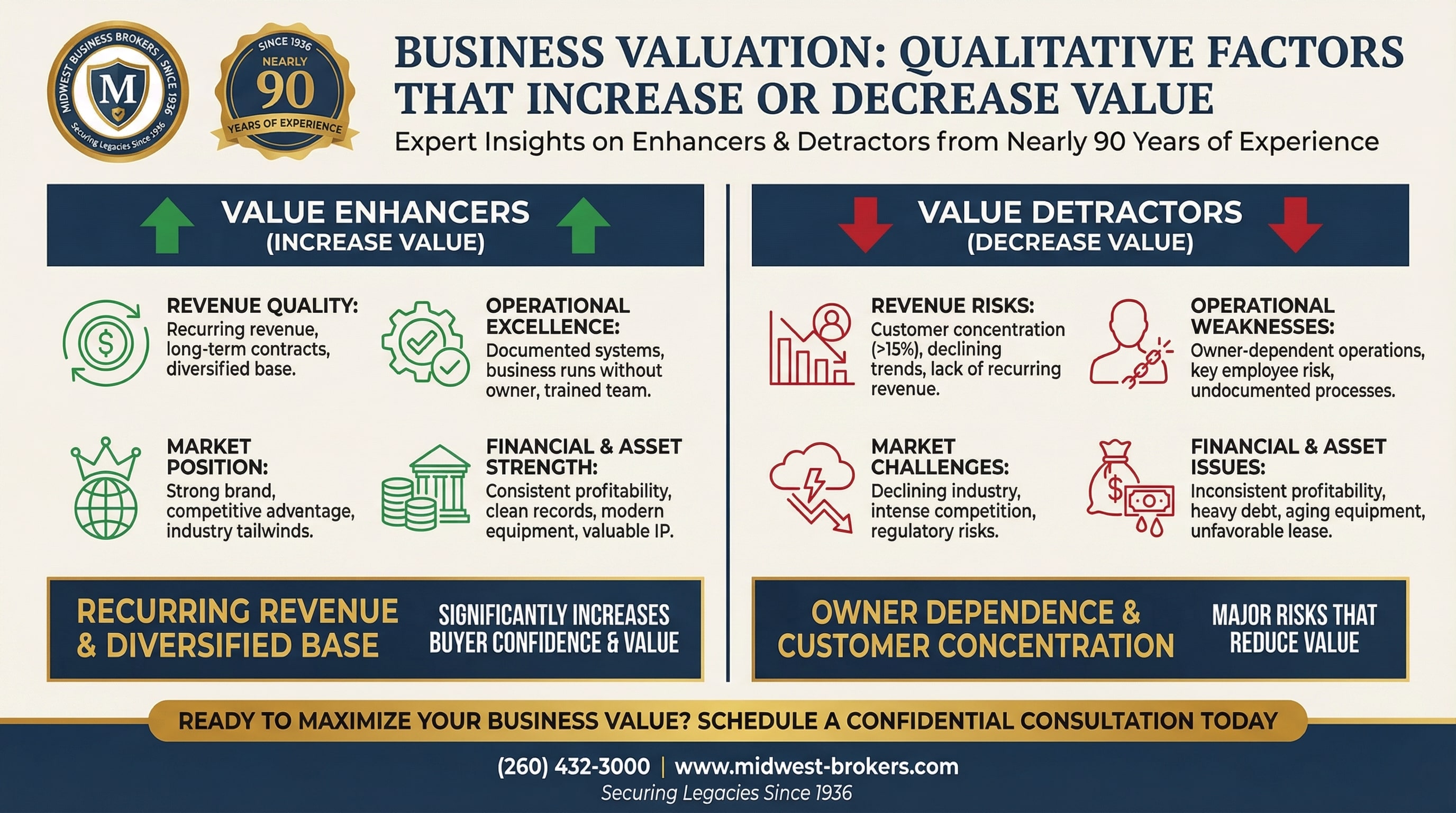
Beyond basic financial performance, qualitative factors significantly impact what buyers will pay.
Value Enhancers (Factors That Increase Value)
Revenue Quality:
✓ Recurring revenue (subscriptions, contracts, repeat customers)
✓ Long-term customer contracts with renewal provisions
✓ Diversified customer base (no single customer dominates)
✓ Growing revenue trends (year-over-year increases)
✓ High customer retention rates
✓ Pricing power (ability to raise prices without losing customers)
Operational Excellence:
✓ Documented systems and processes (SOPs, training manuals)
✓ Business operates successfully without owner's daily involvement
✓ Trained management team in place
✓ Low employee turnover
✓ Cross-trained staff (no single points of failure)
✓ Modern technology and efficient operations
Market Position:
✓ Strong brand recognition and reputation
✓ Competitive advantages (patents, exclusive agreements, proprietary processes)
✓ Barriers to entry that protect market position
✓ Industry tailwinds (growing market, favorable trends)
✓ Geographic advantages (prime location, territory exclusivity)
Financial Strength:
✓ Consistent profitability across economic cycles
✓ Strong gross margins compared to industry
✓ Clean financial records with clear audit trail
✓ Low working capital requirements
✓ Minimal debt obligations
Asset Quality:
✓ Modern, well-maintained equipment
✓ Favorable lease terms (long-term, transferable, reasonable rent)
✓ Valuable real estate (if included)
✓ Intellectual property (trademarks, patents, trade secrets)
✓ Proprietary technology or software
Value Detractors (Factors That Decrease Value)
Revenue Risks:
✗ Customer concentration (one customer = >15% of revenue)
✗ Declining revenue trends
✗ Lack of recurring revenue (all one-time transactions)
✗ Short-term or at-will customer relationships
✗ Revenue dependent on owner relationships
✗ Pricing pressure from competition
Operational Weaknesses:
✗ Owner-dependent operations (business can't run without owner)
✗ Key employee risk (critical staff with no backup)
✗ Undocumented processes and procedures
✗ High employee turnover
✗ Outdated technology or inefficient operations
✗ Quality control issues or customer complaints
Market Challenges:
✗ Declining industry or market disruption threats
✗ Intense competition with limited differentiation
✗ Regulatory risks or compliance challenges
✗ Geographic limitations or unfavorable location
✗ Commodity products with no pricing power
Financial Concerns:
✗ Inconsistent or declining profitability
✗ Below-industry margins
✗ Heavy working capital requirements
✗ Significant debt obligations
✗ Cash business with difficult-to-verify revenue
✗ Mixed personal and business expenses
Asset Issues:
✗ Aging equipment requiring significant capital investment
✗ Unfavorable lease terms (short-term, non-transferable, above-market rent)
✗ Environmental liabilities or contamination
✗ Pending litigation or unresolved legal issues
✗ Deferred maintenance backlog
PART 5: THE PROFESSIONAL VALUATION PROCESS
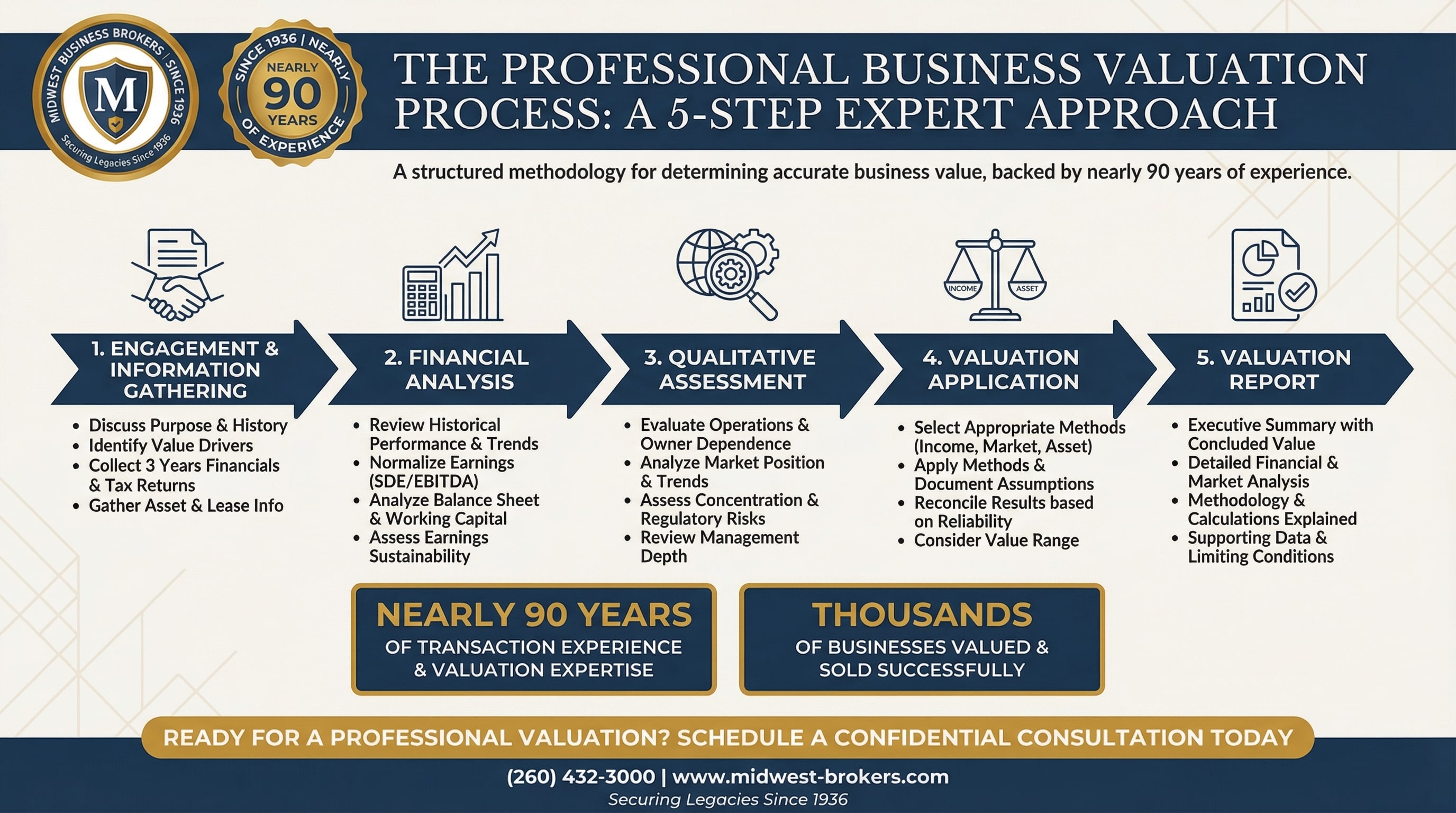
Understanding how professionals approach valuation helps you prepare for the process and interpret results.
Step 1: Engagement and Information Gathering
Initial Consultation:
- Discuss purpose of valuation
- Understand business history and operations
- Identify key value drivers and concerns
- Establish timeline and deliverables
Information Requested:
- Three years of financial statements (P&L, balance sheet)
- Three years of tax returns
- Asset lists with acquisition dates and costs
- Lease agreements
- Customer and revenue breakdowns
- Employee roster and compensation data
- Corporate documents and contracts
- Industry and market information
Step 2: Financial Analysis
Historical Performance Review:
- Analyze revenue trends and composition
- Examine profitability patterns
- Identify seasonal variations
- Compare performance to industry benchmarks
Earnings Normalization:
- Identify all add-backs and adjustments
- Document and verify each adjustment
- Calculate normalized SDE and/or EBITDA
- Assess sustainability of normalized earnings
Balance Sheet Analysis:
- Review asset composition and condition
- Assess working capital requirements
- Identify any off-balance-sheet items
- Evaluate debt and liabilities
Step 3: Qualitative Assessment
Business Operations:
- Owner dependence and transition risk
- Management depth and capability
- Employee stability and expertise
- Systems and documentation quality
Market Position:
- Competitive landscape analysis
- Industry trends and outlook
- Customer relationships and loyalty
- Growth opportunities and threats
Risk Assessment:
- Concentration risks (customer, supplier, key person)
- Regulatory and compliance factors
- Technology and obsolescence risk
- Legal and environmental issues
Step 4: Valuation Application
Select Appropriate Methods:
- Income approach (typically primary for operating businesses)
- Market approach (for market evidence support)
- Asset approach (if applicable)
Apply Methods:
- Calculate value under each selected method
- Document assumptions and data sources
- Consider range of values under different scenarios
Reconcile Results:
- Weight results based on reliability and applicability
- Consider all qualitative factors
- Arrive at concluded value or value range
Step 5: Valuation Report
Professional valuation reports typically include:
- Executive summary with concluded value
- Description of business and industry
- Economic and market conditions
- Financial analysis and normalized earnings
- Valuation methodology and calculations
- Supporting data and assumptions
- Limiting conditions and qualifications
PART 6: COMMON VALUATION MISTAKES
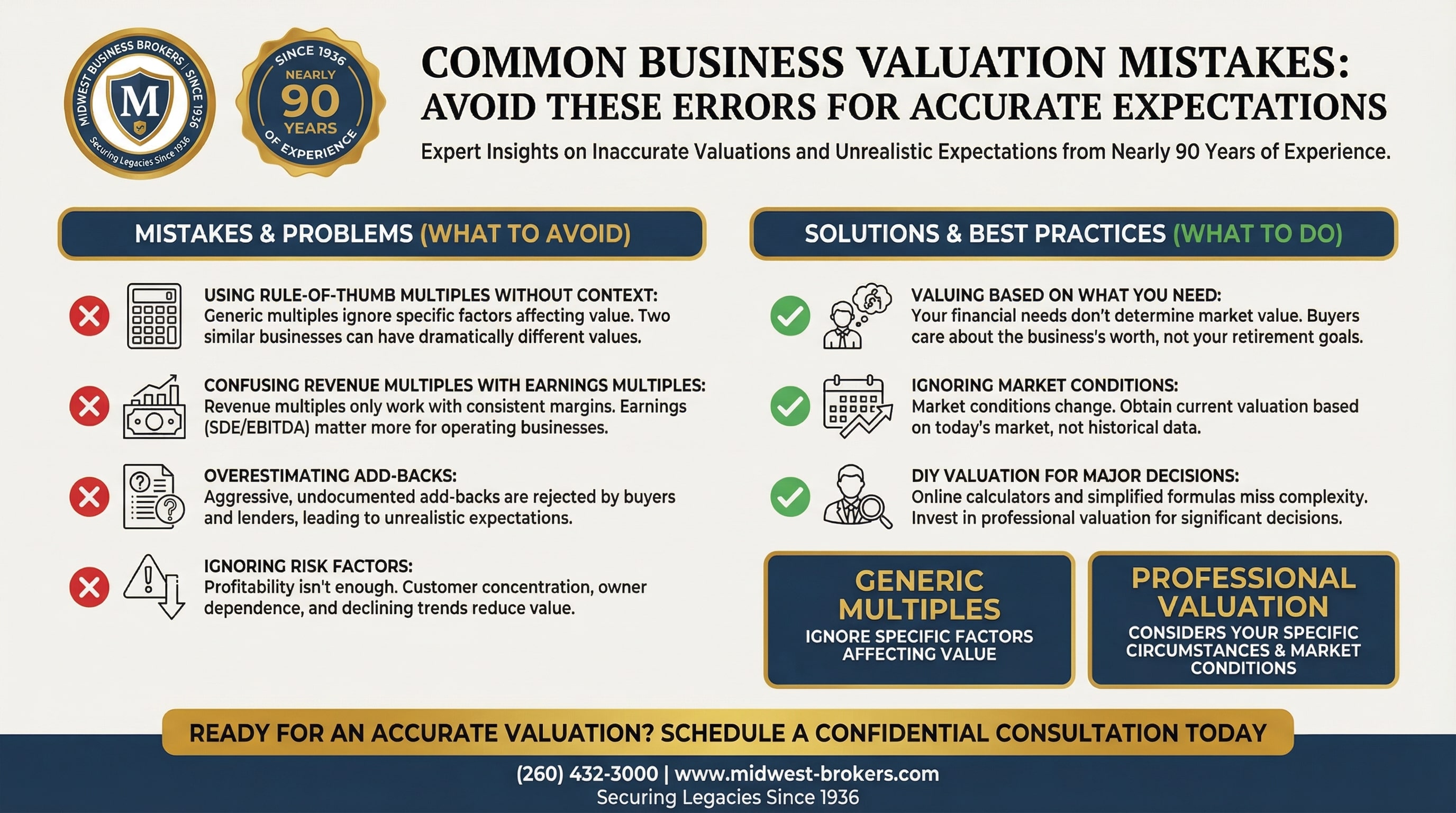
Avoid these errors that lead to inaccurate valuations and unrealistic expectations.
Mistake 1: Using Rule-of-Thumb Multiples Without Context
"I heard businesses like mine sell for 3x earnings."
The Problem: Generic multiples ignore the specific factors that affect your business's value. Two businesses in the same industry with identical revenue can have dramatically different values based on profitability, growth, risk, and quality factors.
The Solution: Professional valuation considers your specific circumstances, not industry averages alone.
Mistake 2: Confusing Revenue Multiples with Earnings Multiples
"My business has $2 million in revenue, and businesses sell for 1x revenue, so it's worth $2 million."
The Problem: Revenue multiples only make sense for businesses with consistent margins. A $2 million revenue business with 5% margins is worth far less than one with 20% margins.
The Solution: Focus on earnings-based valuations (SDE or EBITDA multiples) for most operating businesses.
Mistake 3: Overestimating Add-Backs
"If I add back everything I run through the business, my earnings are much higher."
The Problem: Aggressive add-backs that can't be documented or verified will be rejected by buyers and lenders. Overstated earnings lead to unrealistic price expectations and failed transactions.
The Solution: Include only legitimate, documentable add-backs. Be conservative rather than aggressive.
Mistake 4: Ignoring Risk Factors
"My business is profitable, so it should get top-of-market multiples."
The Problem: Profitability is necessary but not sufficient. Customer concentration, owner dependence, declining trends, and other risk factors reduce what buyers will pay.
The Solution: Honestly assess your business's risk profile and understand how it affects value.
Mistake 5: Valuing Based on What You Need
"I need $2 million to retire comfortably, so that's what my business is worth."
The Problem: Your financial needs don't determine market value. Buyers don't care what you need—they care what the business is worth to them.
The Solution: Separate your financial planning from your valuation expectations. If there's a gap, you may need to enhance value before selling or adjust your plans.
Mistake 6: Ignoring Market Conditions
"Businesses were selling for 4x earnings two years ago, so mine should too."
The Problem: Market conditions change. Interest rates, lending availability, economic outlook, and buyer confidence all affect valuations.
The Solution: Obtain current valuation based on today's market conditions, not historical data.
Mistake 7: DIY Valuation for Major Decisions
"I'll just calculate the value myself using an online calculator."
The Problem: Online calculators and simplified formulas can't capture the complexity of business valuation. Critical decisions based on inaccurate valuations lead to poor outcomes.
The Solution: For sale transactions, partner buyouts, divorce, estate planning, or any significant decision, invest in professional valuation.
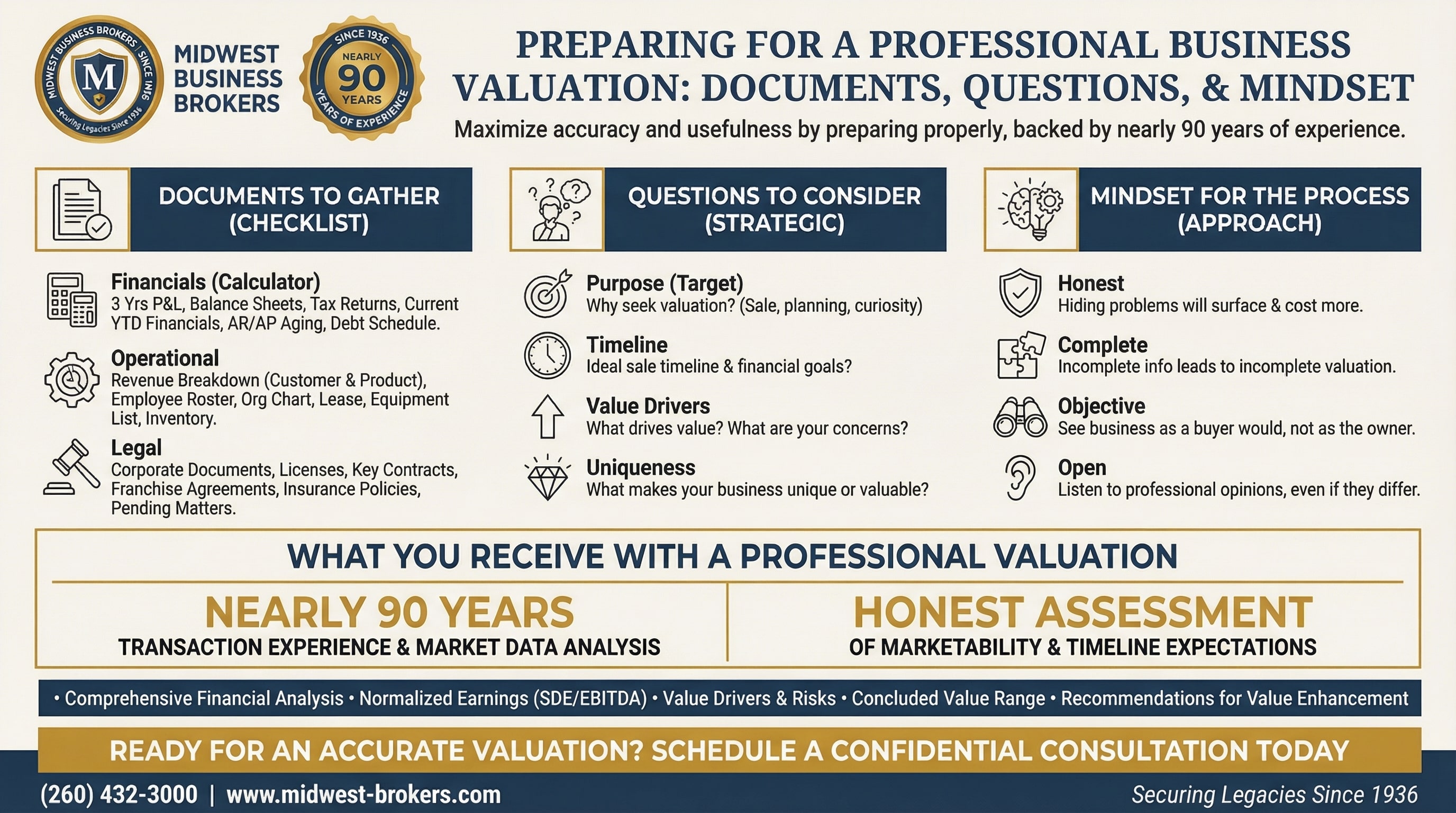
PART 7: PREPARING FOR YOUR VALUATION
Maximize the accuracy and usefulness of your valuation by preparing properly.
Documents to Gather
Financial Documents:
☐ Three years of profit and loss statements (monthly preferred)
☐ Three years of balance sheets (year-end)
☐ Three years of business tax returns (complete with all schedules)
☐ Current year-to-date financial statements
☐ Accounts receivable aging report
☐ Accounts payable summary
☐ Debt schedule (all loans, lines of credit, equipment financing)
Operational Documents:
☐ Revenue breakdown by customer (top 10-20 customers with revenue)
☐ Revenue breakdown by product/service line
☐ Employee roster with positions, tenure, and compensation
☐ Organization chart
☐ Lease agreement for premises
☐ Equipment list with acquisition dates and estimated values
☐ Vehicle list (if applicable)
☐ Inventory summary and valuation method
Legal Documents:
☐ Corporate formation documents (articles, bylaws, operating agreement)
☐ Business licenses and permits
☐ Key contracts (customer, vendor, supplier)
☐ Franchise agreement (if applicable)
☐ Insurance policies
☐ Any pending legal matters
Questions to Consider
Before your valuation consultation, think through:
- Why are you seeking a valuation? (Sale, planning, curiosity)
- What is your ideal timeline for a potential sale?
- What are your financial goals and minimum requirements?
- What do you believe drives value in your business?
- What concerns do you have about your business's value?
- What changes have occurred recently or are expected?
- What makes your business unique or valuable?
Mindset for the Process
Be Honest: Hiding problems doesn't make them disappear—they'll surface during due diligence and cost you more.
Be Complete: Incomplete information leads to incomplete valuations. Provide everything requested.
Be Objective: Try to see your business as a buyer would, not as the owner who built it.
Be Open: Listen to professional opinions, even if they differ from your expectations.
WHEN YOU'RE READY
Understanding business valuation is valuable, but there's no substitute for professional analysis of your specific situation.
Schedule a confidential business valuation consultation. We'll analyze your financials, assess your business's strengths and weaknesses, and provide an honest assessment of what buyers would likely pay in today's market.
Our valuations are based on nearly 90 years of transaction experience, current market data, and professional methodologies that hold up to buyer scrutiny, lender requirements, and—when necessary—legal proceedings.
What You'll Receive:
- Comprehensive analysis of your business's financial performance
- Identification of value drivers and risk factors
- Calculation of normalized earnings (SDE/EBITDA)
- Application of appropriate valuation methodologies
- Concluded value range based on current market conditions
- Recommendations for enhancing value (if applicable)
- Honest assessment of marketability and timeline expectations
 English
  Español de México
  简体中文
简体中文