

Selling an HVAC business starts with making the operation understandable to someone who has never run your shop. Can another person explain the service agreements, reconcile the financial records, coordinate the technicians and handle permit responsibilities without relying on your memory? Preparation can begin well before buyer outreach, but there is no fixed waiting period that suits every owner. Start with the gaps in your own business and a realistic plan for addressing them, rather than assuming that a particular number of months will guarantee a better price.
This guide covers the process of selling — not what your business is worth or how multiples are calculated, but the preparation, buyer review and offer terms to work through before deciding whether a proposed sale meets your objectives.
If you want to discuss the records, service agreements, staffing dependencies, or next steps before buyer outreach, you can Schedule Your Confidential Consultation about your Indiana HVAC business.
For context on Midwest Business Brokers’ history and approach, review the firm overview before deciding whether to schedule a conversation.
The 12-Month HVAC Pre-Sale Preparation Timeline
The twelve-month sequence below is an illustrative planning calendar, not a required minimum or a prediction of when your sale will close. Some tasks can run together; others depend on renewal dates, staffing, financing or records that take time to assemble. An owner facing an unsolicited offer or an urgent personal decision may need a different sequence. Discuss priorities with the appropriate advisers early. Neither a short preparation period nor an incomplete file establishes a fixed percentage discount on the business.
Months 1-2: Financial Cleanup and Three-Year Normalization
Prepare historical profit and loss statements, balance sheets, tax returns and current management reports that can be reconciled. Three years can be a useful starting record set, but the request should fit the business and the intended review. List proposed earnings adjustments separately with their dates, amounts and supporting documents. Truck payments, insurance, phone bills and meals are not automatically add-backs just because an owner authorized them. If an expense supports continuing operations, the buyer may still incur it or need a replacement expense. Have the accountant explain the treatment, avoid counting the same adjustment twice, and distinguish accounting presentation from a buyer accepting the adjustment.
Financial preparation is a starting framework. Every HVAC business has specific issues that are unique to its customer mix, licensing structure, geographic market, and ownership history. A Professional Valuation Assessment can help frame questions about the business records and the scope of any further review. Explain your objectives and timing rather than assuming a preliminary assessment is a formal appraisal or a guarantee of sale readiness.
Review accounts receivable aging with your accountant. Separate current invoices, disputed balances, agreed extended terms and amounts whose collection is uncertain. Document collection history and subsequent receipts so a buyer can assess collectability and working capital. Age alone is not an instruction to write off an invoice; any allowance, write-off or transaction adjustment should reflect the evidence and applicable accounting treatment.
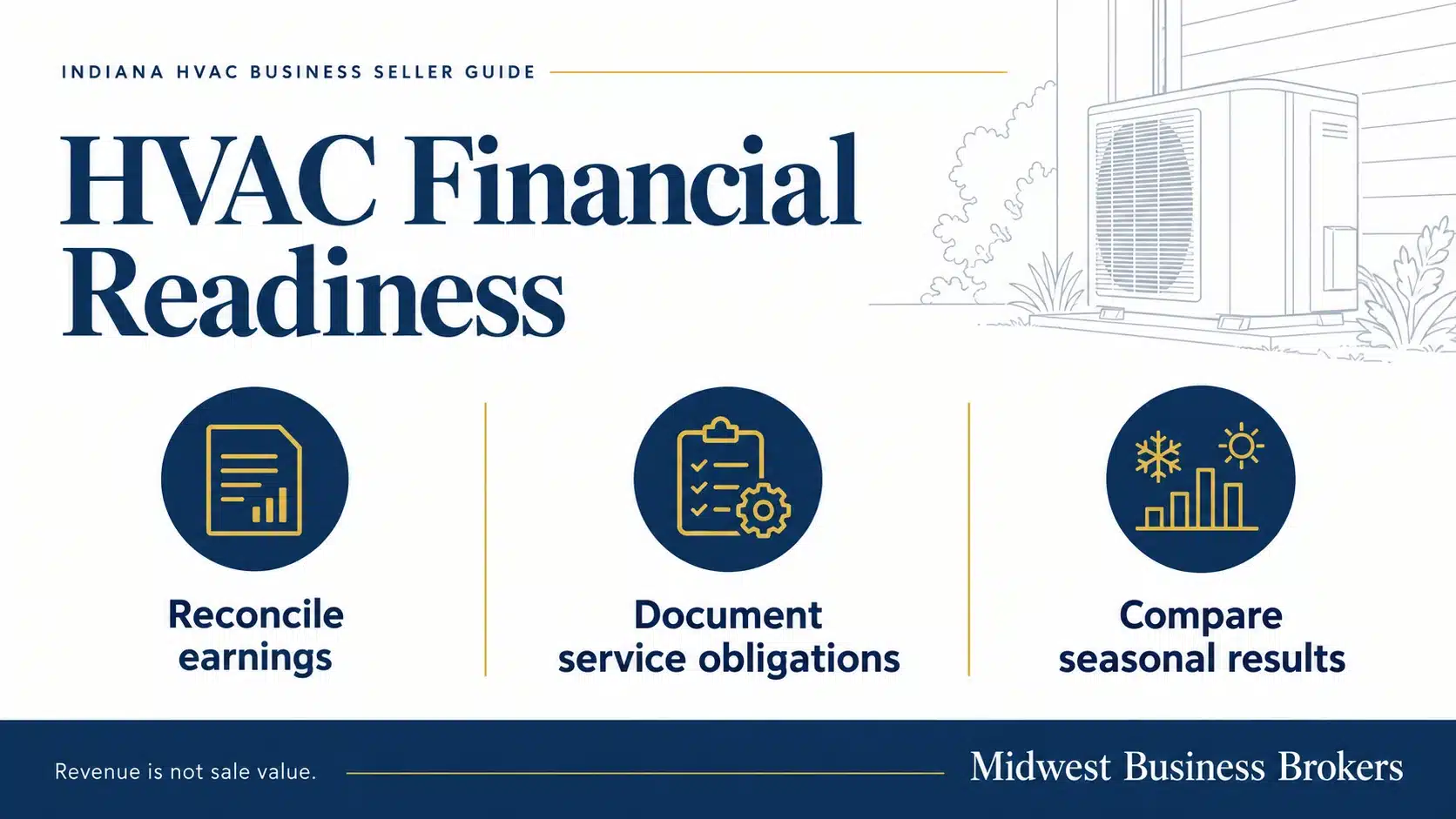
Review monthly results over several years and compare the same months across years before treating a strong summer or quiet winter as a lasting change. Separate maintenance, repair and replacement work, and explain material changes in weather, pricing, staffing and service territory. Heating and cooling degree-day records can provide weather context, but they do not by themselves prove how much a particular company’s revenue or earnings should change. Keep trailing-twelve-month figures alongside comparable-period records and document any proposed adjustment.
Months 3-4: Convert Handshake Service Agreements to Written Contracts
Written maintenance agreements can make customer obligations and service responsibilities easier to evaluate, but they do not guarantee that customers stay after a sale. Informal repeat business can still have value; it needs evidence such as billing history, repeat visits and customer concentration. For signed agreements, review renewal history, cancellation rights, assignment provisions, prepaid balances and the work promised. Ask qualified counsel about transfer requirements rather than assuming that either a signature or a long customer relationship settles the question. There is no universal percentage discount for an informal customer base.
For illustration, 200 maintenance agreements billed at $175 a year represent $35,000 in annual contracted revenue before labor, materials, dispatch, discounts and other service costs. If those customers already bought maintenance, putting the relationship in writing does not automatically create new revenue. To assess the financial effect, document incremental earnings, renewal history, cancellation and assignment terms, and the work needed to deliver the service. Contract revenue alone does not establish a fixed increase in sale price. Before offering discounts to convert customers, check the expected service workload and margin; an agreement that is expensive to fulfill can weaken rather than improve the operation.
Months 5-6: Document Local Credential Dependencies
Credential requirements for HVAC work can depend on the jurisdiction and the work performed. Indiana’s Business Owner Guide explains that contractor licensing is often local. The owner should inventory current credentials, renewal dates, permit history, and the technician or qualifying-person dependencies that a buyer will need to understand.
For a northeast Indiana operation, the Fort Wayne Starting a Business Resource Guide includes heating and air-conditioning contractors among subcontractors licensed to operate in Allen County. The Allen County Building Department provides contractor-licensing information and references ICC HVAC testing roles. Document the actual local requirements and consult the applicable authority and counsel about any transaction-specific treatment; do not assume a particular credential transfers or continues automatically.
Months 7-8: Transition Customer Relationships off Your Personal Cell Phone
Customer relationships that rely on the owner deserve a documented handoff plan. Identify who receives requests, approves pricing and resolves problems for each significant account. The concern is whether those responsibilities can continue after ownership changes, not whether a customer has a particular phone number. Share information and plan introductions with appropriate confidentiality controls, and distinguish a proposed transition from a customer actually agreeing to new arrangements.
Use this stage for a deliberate relationship handoff. Introduce an account manager or service coordinator where appropriate, route service requests through business-managed channels, and document who handles scheduling, pricing and complaints. Coordinate the timing and message with your advisers so customer communication is truthful and proportionate to the stage of the process. For significant commercial accounts, record contacts, service commitments and recent issues. The goal is to demonstrate that the company can serve the account consistently; it is not to promise retention or to imply that a sale requires a fixed number of months of introductions.
Months 9-10: Document Fleet Maintenance Records and Equipment History
For a transaction that includes service vehicles, assemble a fleet schedule showing ownership or lease status, mileage, maintenance history and known repair needs. Include supporting invoices and identify any vehicles excluded from the sale. These records help a buyer evaluate condition and expected expenditure; they do not prove that every assumption in a financial model is correct. A summary linked to the underlying records is more useful than an unsupported assurance that the trucks have been well maintained.
Document the equipment history available for customers in the maintenance portfolio: installed systems, service dates, known warranty terms and open issues. Identify gaps honestly and separate work already billed from future service obligations. The records can support diligence and help the incoming operator plan service delivery. They do not guarantee fewer price adjustments or a faster closing, and they should not be presented as proof of customer renewal without separate renewal evidence.
Months 11-12: Engage an M&A Advisor and Prepare the Confidential Information Memorandum
An adviser can help prioritize the preparation work earlier in the process; month eleven is not the first permitted time to ask for help. When the records are ready for a controlled sale discussion, prepare a Confidential Information Memorandum or other appropriate information package. It can summarize the operation, financial history, revenue mix, customer concentration, agreements, team, facilities, equipment and owner objectives. Share identifying or sensitive material deliberately with qualified recipients under appropriate confidentiality arrangements. A clear package can answer routine questions, but it does not replace buyer diligence or guarantee an offer.
Buyer outreach should follow an explicit readiness decision, not an automatic calendar date. Identify which material issues have been resolved, which remain open and how they will be disclosed. The owner and advisers can then decide whether the business is ready for a confidential process or whether particular work should continue first. Starting a conversation does not require pretending the company is perfect, and waiting until month twelve does not eliminate financial, contractual or operational risk.
What HVAC Buyers Actually Want — and How to Position for Each
Buyer categories are useful for organizing a sale process, but they are not fixed rules about price or deal terms. Potential buyers may include owner-operators, existing local or regional HVAC companies, acquisition entrepreneurs and private-equity-backed platforms. Compare the actual buyer objectives, operating resources, financing and acquisition criteria rather than assuming every member of a category evaluates your business the same way.
PE-Backed Roll-Up Platforms: What They Are Looking For
A platform buyer may consider how an HVAC operation fits its existing services, technician capacity and territory. It may be evaluating an add-on acquisition or a more independent operation, and those objectives can differ. Ask for current acquisition criteria and evidence of the buyer’s ability to execute. Do not infer a particular company’s current interest from an old acquisition announcement or assume that platform ownership makes an offer suitable for your business.
Prepare evidence for these operating questions when discussing buyer fit:
Recurring revenue percentage. Show the proportion of revenue from maintenance agreements alongside profitability, renewal history, billing terms and service obligations. Distinguish contracted maintenance from repeat work without an agreement. There is no universal recurring-revenue threshold that qualifies every HVAC company for a platform buyer. A lower percentage should prompt questions about the business model, not an automatic conclusion that the business cannot be sold to that buyer type.
Technician count and certification depth. Document roles, qualifications, training, tenure, compensation and the work each team member performs. Headcount alone does not establish value: two teams with similar revenue can have different workloads, productivity, subcontracting needs and costs. Identify vacancies, overtime reliance and key-person dependencies so a buyer can evaluate the operating capacity instead of assuming that more technicians always means a higher price.
Geographic density. Provide a service-area map and explain travel time, dispatch arrangements and the mix of residential and commercial work. A buyer may value overlap with an existing territory or may be evaluating a new area. Do not assume that an Indianapolis location guarantees platform interest or that a rural Indiana location rules it out. Current buyer criteria and the company’s operating economics are the evidence that matters.
Management infrastructure. Describe who makes day-to-day decisions and which responsibilities would need to move after a sale. Some buyers have managers available; others may want an existing team or a negotiated seller transition. Owner dependence is a diligence topic, not proof that an earn-out is required. Document responsibilities and discuss feasible handoffs before committing to a post-close role you do not want or cannot perform.
Individual Buyers: What They Are Looking For
An individual buyer may plan to operate the company personally, hire a manager or retain an existing team. Financing can include personal equity and third-party borrowing, including an SBA-backed loan when the transaction and borrower qualify. Confirm the buyer’s operational plan and financing readiness instead of assuming that every individual buyer is purchasing a job or will use the same lending program.
An owner-operator needs to understand how the company will operate after the handoff. Ask about management responsibilities, technician supervision, customer communication and access to the business systems. A buyer may also consider territory, staffing and growth plans, so do not assume that platform fit or geographic questions are irrelevant. Compare the buyer’s proposed operating plan with the people and resources actually available.
Compare financing evidence and execution risk for each offer rather than assuming one buyer category is always more price-sensitive. A lender may review repayment capacity, operating records and the planned transition. Seller financing, escrow arrangements and other conditions should be evaluated from the actual proposal and applicable lending requirements. A request for a longer handoff is not itself a universal financing rule or proof that the owner must accept less cash at closing.
Indiana Market Reality: Where Each Buyer Appears
For an Indiana HVAC business, build the buyer list around the company’s actual service territory, customer mix, staff and capabilities. An Indianapolis operation, a Fort Wayne commercial-service shop and a rural contractor can each present different operating questions, but geography alone does not establish buyer demand or competitive offers. Ask an adviser to explain which potential buyers fit the company and why, using current evidence. Separate a researched candidate list from confirmed interest, and do not treat a recurring-revenue percentage as a promise of multiple offers.

The Deal Structure for HVAC Sales: What You Actually Agree To at the Table
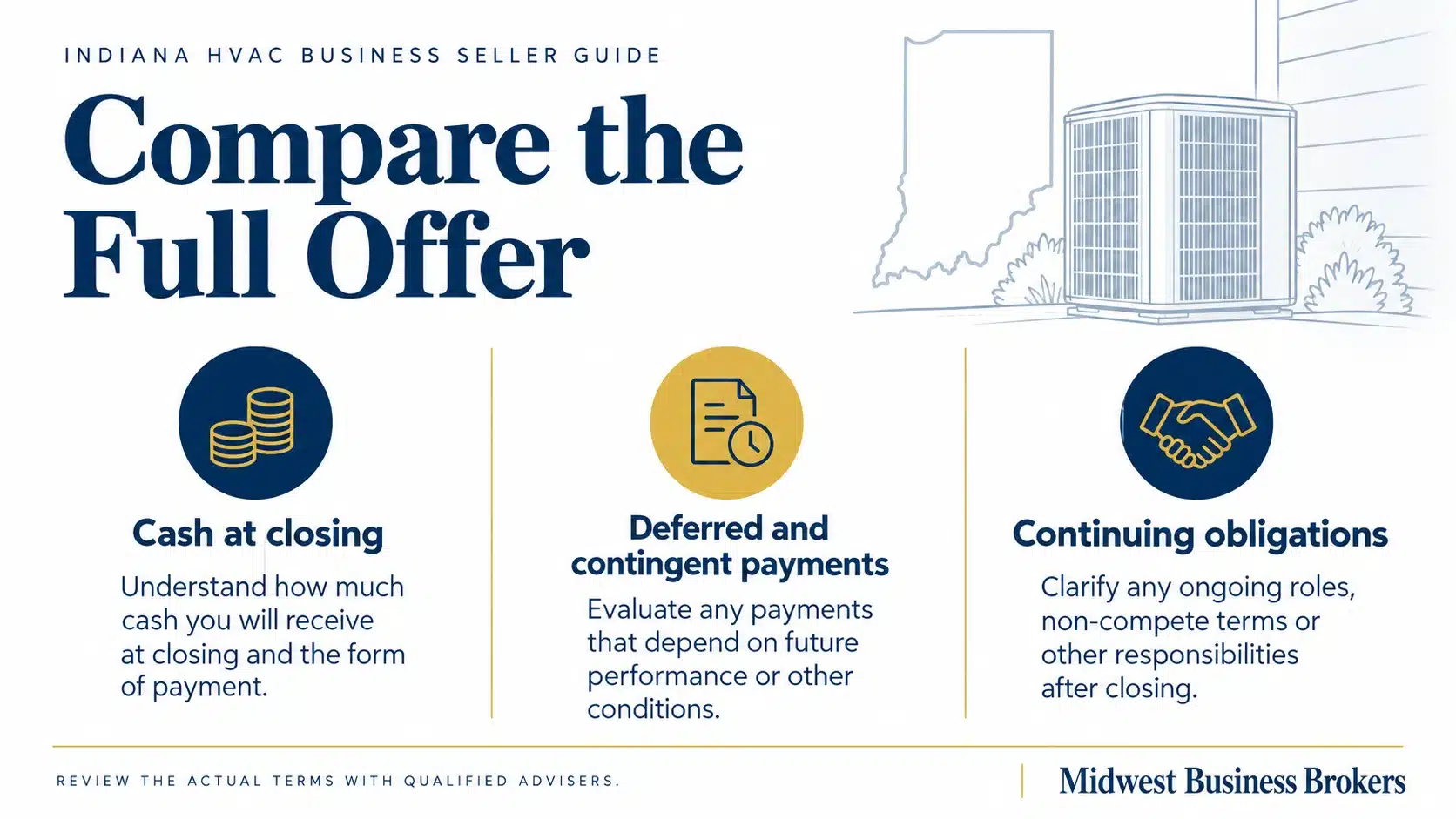
Compare the headline price with when and how the proceeds would be paid. Identify cash at closing, debt repayment, fees, escrows, deferred amounts and contingent payments. Ask which post-close decisions could affect those payments and who would control them.
SBA 7(a) Financing: The Individual Buyer’s Mechanism
SBA’s 7(a) program can support qualifying ownership changes, but an article cannot determine whether a particular buyer or transaction qualifies. The borrower works with a participating lender. Before relying on a financed offer, ask the buyer and lender to clarify the expected funding sources, approval process, conditions and document requests. A loan-program label is not proof of committed funds, a universal equity contribution or the amount the seller will receive at closing.
Prepare the financial and operating information the lender requests and identify any material uncertainties early. If a proposal includes seller financing, ask how its repayment, security and relationship to senior debt will work. Those terms affect the timing and risk of the seller’s proceeds and require transaction-specific review. Do not assume that seller financing is always required, always prohibited or a fixed percentage of the price. Confirm the current requirements with the lender and qualified advisers before signing.
Clarify any proposed seller consulting or transition arrangement with the lender and transaction counsel. Its permitted structure and duration depend on the applicable requirements and the deal. Do not budget around a supposedly mandatory twelve-month consulting obligation. Compare the actual hours, duties, compensation, end date and continuing exposure under each offer, whether the buyer uses SBA-backed financing, another loan or equity capital.
PE Cash-at-Close: The Platform Acquisition Structure
A platform offer can include cash, financing, seller notes, rollover equity or contingent consideration. The buyer’s label and the company’s size do not determine the structure. Request a clear description of funding, approvals and closing conditions. Distinguish enterprise value from the amount payable for the ownership interests and from the seller’s eventual proceeds after debt, expenses and other agreed adjustments.
Cash at closing and post-close consideration should be compared separately. An earn-out is not universal in a private-equity acquisition, and a headline cash offer can still include escrows, adjustments or other conditions. Build an offer comparison from the actual documents: payment at closing, retained or rolled equity, deferred payments, contingent amounts and the seller’s continuing obligations. Have qualified advisers explain the risks instead of assuming that the largest headline number is the best outcome.
For a broader framework for planning your exit across all the dimensions that affect sale outcomes, the Complete Business Exit Strategy Checklist covers the full preparation process from first consideration through closing.
Earn-Out Structures Tied to Customer Retention
An HVAC earn-out, if proposed, may use a measure such as earnings, revenue or customer retention. The parties must define the metric, period and calculation rather than rely on a generic industry formula. For a retention measure, clarify whether it counts customers, agreements or dollars; how renewals and cancellations are treated; and which records will be available to check the result.
Before accepting contingent consideration, ask who controls the decisions that affect payment. Pricing changes, technician availability, service standards and customer communication may influence renewals after ownership changes. The agreement should address the calculation, reporting, payment timing and dispute process, with qualified counsel reviewing the terms. A simple statement that an earn-out is prorated does not tell you the result: there may be thresholds, caps, exclusions or other conditions. Work through the actual formula using more than one outcome, including a case where no contingent payment is earned.
Documented agreements can make an earn-out measure easier to describe and test, but written contracts can also expire, be cancelled or require consent to assignment. Keep the agreement terms and renewal evidence together. Do not count a forecast renewal as a completed renewal or assume that documentation removes the buyer’s operational influence on retention. Evaluate whether the proposed contingent payment fits your objectives and risk tolerance.
Document Seller and Key-Employee Transition Considerations
A purchase agreement can address the seller’s post-close role, employee continuity, customer introductions, and other transition responsibilities. The appropriate terms depend on the transaction and applicable law. Owners are better served by documenting the work they can realistically transition and discussing final agreements with qualified transaction counsel than by relying on generic duration or scope rules.
Transition Planning: What the Buyer Needs to Understand
The seller and buyer should agree on the work to be handed off, the people to be introduced, the information to be transferred, and whether any post-close services are paid. There is no universal transition length or compensation figure for every HVAC sale. Put the proposed scope, duration, payment, and end point in writing and have qualified transaction counsel review the final agreement.
Illustrative HVAC Sale-Preparation Scenario
This simplified scenario is illustrative. It is not a Midwest Business Brokers client outcome, a completed transaction, or a promise of value, deal structure, or timing.
Before going to market, an HVAC owner can document recurring-service agreements, equipment and fleet records, customer-account handoffs, and credential dependencies. The buyer can then evaluate the records in due diligence rather than relying only on an owner’s explanation.
Any purchase-price allocation, earn-out, transition services, and post-close obligations should be negotiated for the particular company and reviewed with qualified legal, tax, and transaction advisers. A broker can help an owner prepare the business and frame the process, but the final economics depend on the business, buyer, diligence, financing, and signed agreements.
HVAC Sale Preparation Checklist
| Preparation Area | Action Required | Illustrative Timing | Impact on Sale |
|---|---|---|---|
| Financial Documentation | 3 years P&L, balance sheets, add-back schedule prepared with accountant | Months 1-2 | Starting records; confirm the actual buyer and lender request |
| Accounts Receivable | Review aging, disputes and collection evidence with the accountant; support any allowance or write-off | Months 1-2 | Helps explain collectability and working-capital questions |
| Service Agreement Documentation | Document maintenance agreements, renewal terms, and customer records | Months 3-4 | Makes recurring-service records easier for a buyer to evaluate |
| Local HVAC Credentials | Document local credentials, permit responsibilities, renewal dates, and qualifying-person dependencies | Months 5-6 | Makes operational dependencies available for diligence |
| Customer Relationship Transition | Plan account handoffs and business-managed contact channels with appropriate confidentiality controls | Months 7-8 | Documents account responsibilities and planned handoffs |
| Fleet Documentation | Compile maintenance records for every service vehicle | Months 9-10 | Supports questions about condition and future expenditure |
| Customer Equipment History | Document installed systems, warranties, service history in CRM for all agreement customers | Months 9-10 | Supports service-history review; confirm renewals and revenue separately |
| Technician Retention | Plan appropriate staffing discussions and evaluate any proposed retention arrangements with advisers | Months 10-11 | Identifies staffing capacity, dependencies and unresolved transition risks |
| CIM Preparation | Prepare a confidential information package; adviser involvement may begin earlier | Month 11 | Organizes supported information for qualified buyer review |
| Buyer Outreach | Begin qualified buyer conversations under NDA | Month 12 | Readiness and timing are reviewed for the particular business |
When you are ready to begin the process seriously, Schedule Your Confidential Consultation to discuss your Indiana HVAC business, objectives and timing with Midwest Business Brokers. Ask about the proposed scope of advice, relevant experience and confidentiality arrangements before sharing sensitive business records.
Frequently Asked Questions: Selling an HVAC Business in Indiana
How long does it take to sell an HVAC business in Indiana?
There is no single preparation or sale timeline for every Indiana HVAC business. The twelve-month calendar in this guide is illustrative; records, staffing, customer agreements, buyer diligence and financing can change the sequence. Start with a readiness review and discuss unresolved issues with the appropriate advisers. A longer preparation period does not guarantee a particular price or closing date.
What are buyers looking for when they buy an HVAC business?
Buyer priorities differ, but useful evidence includes supported financial results, customer and agreement history, technician capabilities, management responsibilities and a workable transition plan. A platform may evaluate operational fit while an individual buyer may focus on how the company will be managed, but those are questions to verify with the actual buyer. There is no universal recurring-revenue percentage that guarantees platform interest or an offer.
How do earn-outs work in an HVAC business sale?
An earn-out is a contingent portion of purchase consideration that the parties define in the purchase agreement. It may be tied to a documented post-close measure, but the metric, period, data source, payment mechanics, and dispute process are transaction-specific. Sellers should understand those terms and have qualified counsel review them before agreeing to an earn-out.
Do I need to stay on after selling my HVAC business?
A seller may agree to a post-close transition, but its duration, scope, and payment are negotiated for the transaction. A useful transition plan identifies the customer and employee introductions, operational knowledge, and service-agreement work that need to be handed off. Put the agreed responsibilities and compensation in writing and have qualified transaction counsel review the final terms.
What is the biggest mistake Indiana HVAC owners make when selling?
A significant preparation risk is presenting claims that cannot be supported by the records. Reconcile the financial statements, document maintenance revenue and renewals, identify key-person dependencies, and review agreement-transfer questions with appropriate advisers. The effect on price or deal terms depends on the company and transaction. There is no universal customer-retention discount or guaranteed sale-price increase from converting informal relationships to signed agreements.
How much is my HVAC business worth?
There is no reliable universal number for an HVAC business. A buyer or adviser will usually need normalized financial records, recurring service-agreement revenue, customer concentration, owner dependence, fleet and equipment condition, backlog, licensing continuity, and the transition plan before discussing a value range. A confidential consultation can help identify which records to organize; it does not create a guaranteed valuation.
How profitable is an HVAC business?
Profitability varies by service mix, labor and subcontractor costs, maintenance agreements, callbacks, fleet overhead, seasonality, and the quality of the records. Use the company’s actual financial statements and a documented normalization process rather than a generic margin or multiple. Owners can begin organizing those facts before choosing a sale date.
Do HVAC contractors need to be licensed in Indiana?
Indiana contractor requirements can vary by city or county. The state’s Business Owner’s Guide describes contractor licensing as a local option for trades other than plumbing, so an owner should confirm permits, registrations, and any qualifying-person requirements in every jurisdiction where the company works before marketing the business. This is a planning prompt, not legal advice.
How much money does a HVAC company owner make?
There is no reliable universal figure. An owner’s personal pay may include salary, distributions, benefits, and discretionary expenses, and a buyer or adviser may normalize those items separately from operating earnings. Review the company’s actual financial statements, owner role, service mix, labor costs, recurring agreements, and debt before discussing value or cash flow. A confidential consultation can help organize the records; it does not predict a guaranteed income or sale price.
 English
  Español de México
  简体中文
简体中文