

Indiana does not issue a standalone business broker license. That is the first thing sellers need to understand. The state says Indiana does not have one single, comprehensive business license, and there is no separate Indiana credential that screens who gets to market themselves as a business broker. So the person pitching your $3.5 million company may be a seasoned intermediary with dozens of closes behind him, or a salesperson who learned three acronyms last month.
That is why credentials exist. CBI, CBB, and the middle-market M&A designations were built to create a floor: education, ethics, deal exposure, and continuing education. A floor matters. But a floor is not a ceiling. Sellers who hire on letters alone still get hurt on price, confidentiality, and broken deals.
When comparing brokers, ask for relevant transaction experience and verify what each credential represents. For an initial value discussion, our Business Valuation Service includes a free calculator that provides a preliminary estimate from your inputs. It does not verify your records, validate a broker’s proposed price, or replace a purpose-specific appraisal. Use it to prepare questions about the earnings, risks, and transaction terms behind a valuation.
One point of cleanup before we start. Sellers often use “M&AI” as a catch-all phrase for middle-market credentials. As of April 9, 2026, the live designations you are more likely to see are M&AMI from M&A Source and CM&AA from AM&AA. That distinction matters once your deal moves beyond small-business territory, so this guide will address the terminology directly instead of pretending the labels are interchangeable.
Why Business Broker Credentials Exist – and What They Do Not Guarantee
In Indiana, credentials fill a trust gap. There is no state-issued business broker license that confirms someone understands deal structure, recasting, seller screening, confidentiality, or buyer qualification. That leaves trade associations to do part of the filtering. IBBA, CABB, M&A Source, and AM&AA all try to create standards the state does not.
That said, no credential guarantees excellence. It does not guarantee your broker knows your industry. It does not guarantee they can protect confidentiality in a tight Fort Wayne market where vendors, lenders, and competitors all know each other. It does not guarantee they know how to negotiate a working-capital peg, survive due diligence, or keep a search-fund buyer from wasting six months of your life.
It also does not mean zero regulation. If your sale includes owned real estate, Indiana real estate licensing rules can come into play. If the deal is structured as a securities transaction, federal securities rules still matter even though Congress created a statutory M&A broker exemption for qualifying private-company transfers effective March 29, 2023. So the right way to think about credentials is simple: they are one screen, not the whole screening process.
Most sellers should care about three questions in this order. First, has this person closed real deals like mine? Second, can this person defend value with numbers a buyer’s CPA will respect? Third, do the credentials support that story or are they standing in for it? If a broker has one credential and 25 solid closes in Indiana manufacturing, logistics, healthcare, or business services, that profile beats a lightly tested broker with four letters and weak proof every time.
| Credential | Issuer | Hard numbers behind it | What it usually signals to an Indiana seller | What it still does not prove |
|---|---|---|---|---|
| CBI | IBBA | 68 course hours, 1 conference, 3 seller-side transactions, comprehensive exam with 70%+ per section | The broker has completed serious brokerage education and documented real deal work | Industry depth, Indiana track record, or consistent premium outcomes |
| CBB | CABB | 5 sold business deals in 4 years, 2 conferences, required coursework, ethics commitment | The broker has met a real association standard, usually with California-heavy training | Indiana execution, national buyer reach, or middle-market depth |
| M&AMI | M&A Source | 3 years full-time M&A experience, 3 transactions of $5M+ each, advanced coursework, 2 conferences | The advisor has operated in larger, more complex private-company transactions | Fit for a small SBA-style deal or seller communication discipline |
| CM&AA | AM&AA | 40 CPE hours, exam, middle-market curriculum, preferred prior professional or deal experience | The advisor has structured training for lower-middle-market and middle-market transactions | Actual sell-side closing volume by itself |
The table is the short version. The long version matters more, because the details tell you when a credential is useful and when it is just branding.
CBI Usually Means the Broker Can Run a Real Sale Process
The Certified Business Intermediary, or CBI, is the credential Indiana sellers will see most often from serious lower-middle-market business brokers. It is issued by the International Business Brokers Association, and the current IBBA policy manual is more demanding than most owners assume.
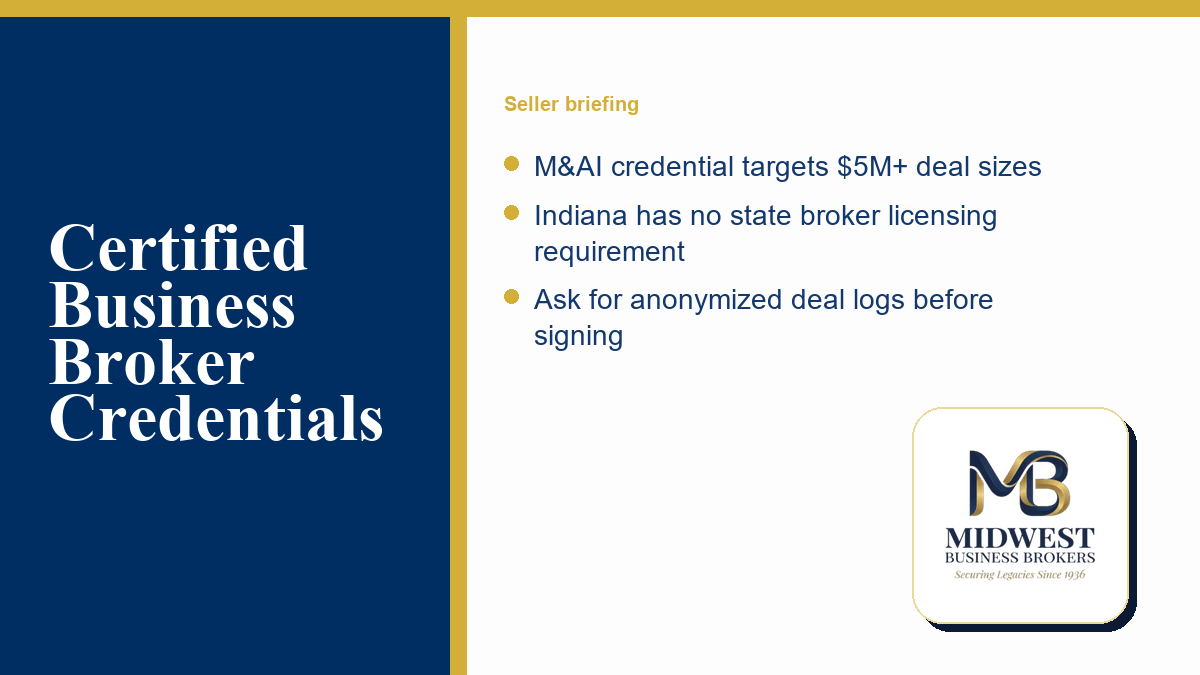
Under the current IBBA rules, a CBI candidate must do all of the following within the three years preceding the application:
- Maintain IBBA membership in good standing
- Attend at least one IBBA conference
- Complete 68 credit hours of approved education, including 52 required hours and 16 elective hours
- Pass each course exam with a score of 70% or higher
- Provide evidence as lead seller broker on 3 going-concern business transactions
- Pass the comprehensive CBI exam with 70% or higher in each required section
The education requirement is not fluff. The required classes cover ethics, legal aspects of business brokerage, financial analysis, pricing, and the mechanics of selling privately held companies. That matters to sellers because the weakest brokers almost always fail in the same places: they cannot recast financials correctly, they cannot support add-backs, and they cannot manage the deal once diligence starts.
What CBI Actually Proves to a Seller
CBI does not prove you have found the best broker in Indiana. It does prove something useful: the broker has documented at least three real seller-side transactions and passed a body of coursework that is directly tied to the sale process. That is a meaningful baseline in a state where no separate business-broker license filters the field.
Just keep the threshold in perspective. Three transactions is the minimum, not the target. A broker can become a CBI with far less repetition than most sellers would want for a $4 million industrial company or a $7 million healthcare services business. So when you hear “I’m a CBI,” the right follow-up is not admiration. It is: “Good. How many deals like mine have you closed in the last 36 months, and what role did you personally play?”
That is where transaction count matters more than the letters. If Broker A is a CBI with 4 lifetime closes and Broker B is a CBI with 22 closes in Indiana distribution, manufacturing, and B2B services, those are not remotely the same profile. The credential is identical. The execution risk is not.
Why the IBBA Network Can Help Indiana Owners
IBBA membership matters beyond the coursework. Sellers in Indiana often need buyer reach outside their local market, especially for niche companies in Fort Wayne manufacturing, Indianapolis distribution, specialty healthcare, and founder-owned service businesses that need more than one local buyer to create pressure. IBBA gives brokers access to a national peer network, conferences, forms, market data, and a public directory that can widen the buyer funnel.
The rarity of the credential also helps. Using the live IBBA public directory data on April 9, 2026, there were 2,708 active broker profiles, 469 active CBI-designated profiles worldwide, and 422 active CBI profiles in the United States. In plain English: CBI holders are a minority even inside the main trade association. That makes the credential meaningful. It just does not make it decisive.
The Numbers Behind the Seller’s Reading of a CBI
Most owners make a simple mistake here. They hear “68 hours of education” and assume the credential is mostly classroom theory. It is not. The requirement that matters more is the combination of deal proof plus testing. The broker has to show seller-side transactions and then pass a comprehensive exam that covers the discipline behind those transactions.
That becomes useful when your deal depends on recasting judgment. Take a typical Indiana company with $900,000 of stated EBITDA, a truck lease running through the business, one family member on payroll above market, and $65,000 of personal travel mixed into operating expense. A broker who cannot normalize that correctly can misprice the business by a full turn of EBITDA. On a 4.75x multiple, that is not a technical error. That is hundreds of thousands of dollars.
So if you are selling a $2 million to $5 million business, CBI is usually the first credential worth noticing. It tells you the broker has at least crossed the line from casual salesperson to trained intermediary. Then you still need to test whether that intermediary is any good.
CBB Is Real, but Indiana Sellers Need to Understand Its Geography
Certified Business Broker, or CBB, is issued by the California Association of Business Brokers. It is not fake. It is not a vanity acronym. But it is also not a national gold standard in the way many sellers assume when they see the word “certified.”
CABB’s own seller-facing description says the designation has been awarded to fewer than 100 recipients statewide and describes CBB holders as brokers with minimum full-time experience, ethics obligations, continuing education, and documented successful closings. The current public CBB application adds more precision. To qualify, the broker must be an active CABB member, agree to the code of ethics, complete required CABB courses or approved waivers, show proof of 5 business transactions closed within the prior 4 years, and attend 2 industry conferences within that same period, with at least one being a CABB conference.
The transaction proof matters. The application says those 5 deals must be business transactions, not pure real estate, and each must hit at least one financial threshold: either a minimum purchase price of $100,000 or a minimum gross success fee of $10,000 to the broker. That is real screening. It is just screening designed by a California association for California business brokers.
How CBB Differs From CBI
The biggest difference is scope. CBI is built as a national business-intermediary credential. CBB is built inside a state association whose coursework includes California-specific brokerage issues. That means the credential can be very useful if your broker’s practice is heavily tied to California transactions, franchise resales, or cross-state buyer pools with California exposure. It matters less if you are a seller in Indiana trying to choose between local execution and distant branding.
The second difference is what the public requirements emphasize. CBI clearly advertises a comprehensive exam and a more formalized credit-hour path. CABB’s public application emphasizes coursework, conferences, ethics, and closed deals. That is not worse. It is just different. For Indiana sellers, it means CBB should be read as a credible regional credential, not as an automatic substitute for a national transaction standard.
When CBB Matters and When It Does Not
CBB matters if the broker built a serious practice in a large, competitive state and can show you actual cross-market transactions. It can also matter when the broker pairs CBB with CBI, M&AMI, or a strong Indiana deal log. In that case the letters are reinforcing a broader story of competence.
It does not matter much when it is the only proof on the table. If a broker shows you CBB but cannot show Indiana references, cannot explain buyer qualification, and has no local transaction history in your size bracket, the credential should not rescue them. A Fort Wayne machine shop seller, an Indianapolis HVAC seller, and a South Bend distribution seller need somebody who knows how buyers actually behave in Indiana’s lower-middle-market lane.
One more practical warning: many websites use the phrase “certified business broker” as generic marketing copy. That is not the same thing as holding the actual CABB CBB designation. Ask who issued the credential, what year it was earned, and whether it is currently active.
What “M&AI” Usually Means in 2026 for a $5M+ Indiana Deal
This is where sellers get confused, and for good reason. People throw around “M&AI” as though it were one universal middle-market badge. It is not. As of April 9, 2026, the two designations you are more likely to encounter in the market are M&AMI from M&A Source and CM&AA from AM&AA.
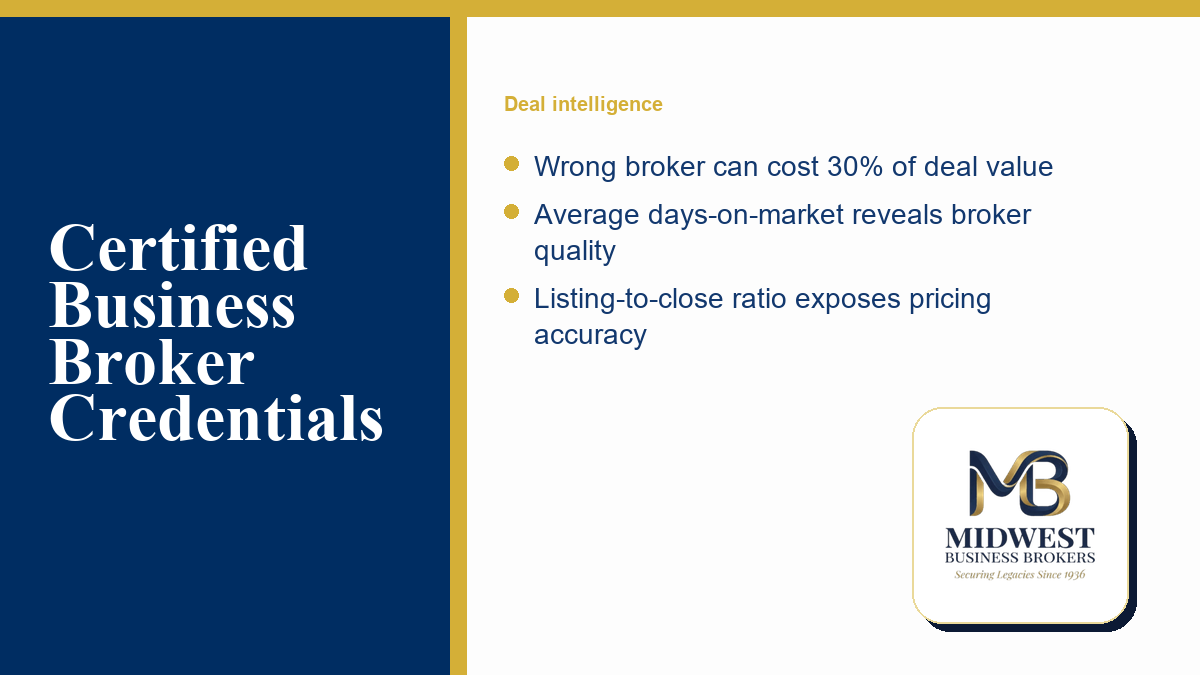
That matters because once your Indiana deal starts moving above roughly $5 million, the buyer pool changes. Instead of mostly individual buyers and SBA-backed buyers, you start seeing family offices, search funds, private equity groups, larger strategics, and more sophisticated diligence teams. The process gets heavier. Working-capital targets, quality-of-earnings reviews, tax structuring, rollover equity, and management presentations start to matter more than the blind teaser alone.
M&AMI Is the Transaction-Heavy Middle-Market Credential
M&A Source’s Merger & Acquisition Master Intermediary, abbreviated M&AMI, is the cleaner proxy for what many sellers mean when they say “M&A credential.” The current requirements are materially tougher than CBI. The candidate must:
- Maintain M&A Source membership
- Show 3 years of full-time M&A deal-making experience within the last 10 years
- Hold a CBI and complete 20 M&A Source credit hours, or complete 40 hours if the candidate is not already a CBI, or complete the CM&AP program
- Attend 2 M&A Source conferences
- Submit 3 M&A transactions, each with total value of at least $5 million
That last line is the one Indiana sellers should care about. Three transactions at $5 million or more tells you the advisor has been exposed to larger, more complex processes. Not guaranteed excellence, but real exposure. On April 9, 2026, the live IBBA/M&A Source public directory showed 138 active M&AMI profiles worldwide and 128 active M&AMI profiles in the United States. That is far rarer than CBI, which is why the designation can carry more weight on a bigger deal.
Recertification is also meaningful. M&AMI holders have to recertify every three years, including conference attendance and at least 36 credit hours. So unlike a credential earned once and then used forever in a bio, this one requires continued participation.
CM&AA Is the AM&AA Credential Sellers Will Actually See
If your broker or advisor says they are tied to AM&AA, the live credential name you should expect to see is CM&AA, not M&AI. AM&AA currently markets CM&AA as a 40-CPE-hour program with an online exam, and its broader membership network spans 25 countries and more than 1,100 professional-services firms. AM&AA says its members represent buyers and sellers in transactions ranging from $5 million to $500 million.
CM&AA is not the same kind of screen as M&AMI. It is broader and more education-driven. Many holders come from accounting, legal, valuation, corporate development, or investment-banking backgrounds rather than classic Main Street brokerage. That can be a plus on a larger Indiana deal where the advisor has to coordinate tax, legal, capital structure, and diligence issues. It just means you should confirm the person has actually closed seller-side transactions rather than assuming the classroom work alone answers that question.
Why This Matters More Once the Deal Stops Looking Like Main Street
The lower-middle-market distinction is not academic. A $1.6 million Indiana HVAC company with $550,000 of normalized SDE is usually sold to an individual buyer using SBA debt, seller training, and a relatively simple asset-purchase structure. A $6.8 million Indiana manufacturer with $1.3 million of EBITDA is a different animal. Buyers may push for a quality-of-earnings report, inventory testing, customer-concentration analysis, and a more heavily negotiated purchase agreement.
That is why middle-market credentials matter more in the $5 million and up zone. They indicate the advisor has at least spent time in processes where diligence is deeper and the capital behind the buyer is more sophisticated. For a sub-$2 million seller, a sharp CBI with heavy Main Street repetition may be the better fit. For a $2 million to $10 million seller, the answer depends on where your company sits on the spectrum. The closer you get to institutional buyers and EBITDA-driven pricing, the more useful M&AMI or CM&AA becomes.
In Indiana specifically, that tends to show up in Indianapolis, Fort Wayne, Elkhart, and Northwest Indiana industrial deals where strategic buyers or private-capital-backed buyers can justify a premium. A broker who only knows owner-operator deals will feel that shift quickly, and you will feel it in diligence even faster.
The Questions Indiana Sellers Should Ask Instead of Staring at Acronyms
Most owners ask the wrong first question. They ask, “What credentials do you have?” The better question is, “Can you prove you know how to sell my business?” That is a different conversation.
Take this checklist into the first meeting and make the broker answer it with numbers, not speeches:
- How many deals have you closed in my industry? Do not settle for “we have worked with a lot of service businesses.” Ask for your exact vertical and a date range.
- What is your average or median days-on-market for sold listings in my size range? Median is better than average because it strips out outliers.
- What was the listing-to-close price ratio on your last 10 sold deals? Ask for the actual math, not a rounded percentage.
- Can I speak to 3 recent sellers you represented? Recent means recent. Not from 2018.
- How do you qualify buyers before they see the full package? You want proof-of-funds, lender conversation, and strategic fit, not just an NDA.
- What happens if the deal falls through in diligence? Ask who controls the buyer pipeline, what the re-market plan looks like, and whether any extra fees trigger.
The listing-to-close ratio question is one of the best filters in the room because weak brokers hate it. Here is the math. If the broker’s last 10 sold listings carried aggregate initial asking prices of $31.7 million and aggregate closing prices of $28.6 million, the ratio is 90.2%. That is a real data point. If the broker says “we usually get around asking” but cannot show the totals, you are listening to marketing.
The same goes for days-on-market. Ask whether they are measuring from listing date to LOI, or listing date to close. Those are different metrics. A broker who closes in 240 days with disciplined buyer screening may be stronger than a broker who gets LOIs in 60 days and then burns out in diligence. To explore representation, review MWB’s business brokerage services and bring questions about scope and contract terms to the initial discussion.
Transaction count is where credentials meet reality. A CBI who has closed 18 deals in the last three years and can show a disciplined price-to-close record is more attractive than a broker with a longer title and no evidence. We see this in Indiana constantly. Owners get impressed by terminology and skip the proof. Then the first real buyer exposes how thin the process actually is.
Before verifying voluntary designations, separate them from the business broker licensing requirements that may apply to real estate or a transaction’s structure.
How to Verify a Business Broker’s Credentials and Track Record Without Guessing
Verification is not hard. Most owners simply do not do it.
Start with the issuing body. If the broker claims CBI, check the IBBA directory. If they claim M&AMI, check the same public IBBA/M&A Source directory. If they claim CBB, ask whether it is the actual CABB designation and verify it through the association. If they claim CM&AA, ask when it was earned and whether they are active with AM&AA.
Then move to business legitimacy. Confirm the firm is properly registered with the Indiana Secretary of State through INBiz. If the sale includes real estate, confirm whether the person handling that part of the transaction holds the required Indiana real estate license. This is where a lot of sellers get sloppy. They assume “business broker” covers everything. It does not.
Online reviews can help, but only with caveats. BBB, Google, and niche review sites tell you more about responsiveness and client experience than they do about actual deal skill. A broker can be pleasant and still cost you money. Use reviews as one input, not a verdict. For an overview of MWB’s seller support, explore our Indiana business brokerage services.
What to Ask For If You Want Real Proof
The most useful proof is an anonymized deal log. A serious broker should be able to provide a simple table showing industry, revenue range, SDE or EBITDA range, list price, close price, and approximate timeline for recently sold deals. Names can stay out of it. The numbers should not.
Ask for enough detail to answer these questions:
- Were the deals mostly under $1 million, or do they overlap with your size range?
- Were they asset sales, stock sales, or both?
- How many required seller financing?
- How many died in diligence before the broker eventually closed something else?
- How many were in Indiana versus out of state?
If the broker refuses to provide any verifiable deal evidence, that is a red flag. If they pressure you to sign immediately because “we have buyers waiting,” that is another red flag. If they cannot explain how confidentiality is staged before the full confidential information memorandum goes out, that is a third.
One more test is worth using: ask for three recent seller references and call every one of them. Not email. Call. Ask whether the broker did what they promised, whether the buyer was truly qualified, whether confidentiality was protected, and whether the closing matched the original expectations. Sellers who do that homework almost always make a better hire.
The Real Cost of Choosing the Wrong Broker in Indiana
The wrong broker does not usually fail in a dramatic way on day one. The damage shows up in pricing mistakes, stale time on market, buyer leakage, and bad diligence management. By the time the seller realizes what happened, the market has already repriced the business downward.
Underpricing Costs Real Money Fast
Suppose your Indiana company produces $750,000 of defendable SDE and the market would realistically support a 4.0x multiple. That implies roughly $3.0 million of value. A broker who misses valid add-backs and only supports $650,000 of SDE may pitch the same company at 3.6x to 3.8x that reduced number, or roughly $2.34 million to $2.47 million. That is not a small discount. That is half a million dollars or more lost before the first buyer even signs an NDA.
Overpricing Creates the Slow-Motion Disaster Sellers Hate
The opposite mistake is just as expensive. A composite scenario we see in Indiana looks like this: a business that should have been marketed around $3.0 million gets listed at $4.2 million because the broker wants the engagement. At $750,000 of SDE, that asking price implies a 5.6x multiple, which was never going to hold for the actual buyer universe. The listing sits for 14 months, buyers assume there is a hidden problem, the seller cuts price multiple times, and the company finally sells for $2.6 million.
Run that math. Compared with the original ask, the seller is down $1.6 million. Compared with the more realistic early-market value of $3.0 million, the seller is still down $400,000. And that number ignores the cost of waiting 14 months while management gets tired, capex gets deferred, and trailing-twelve-month performance becomes harder to defend.
Confidentiality Breaches Hit Harder Than Sellers Expect
Indiana is not New York. In Fort Wayne, Elkhart, South Bend, and even large parts of Indianapolis, people know each other. A sloppy teaser in the wrong inbox can reach an employee, a vendor, or a competitor fast. Once key staff think a sale is imminent, retention risk goes up. Once a competitor thinks you are distracted, pricing pressure follows.
If one key manager leaves and your trailing twelve months of EBITDA slips from $900,000 to $780,000 before close, a buyer paying 4.5x EBITDA just took $540,000 of value off the table. That is how confidentiality errors become valuation errors.
Unqualified Buyers Waste More Than Time
The unqualified-buyer problem is brutal because sellers often mistake activity for progress. Six months spent with a buyer who never had financing is not a neutral outcome. If revenue softens during that period, working capital gets tighter, or owner fatigue shows up in the numbers, the business you bring back to market may be weaker than the one you started with.
Say an Indiana services company drops from $900,000 of EBITDA to $750,000 while management waits on a buyer who cannot close. At a 4.5x multiple, that $150,000 earnings drop can translate into roughly $675,000 of value loss. Sellers focus on the six months. Buyers focus on the damaged trailing numbers. The broker should have prevented that buyer from reaching the table in the first place.
This is the central point of the whole discussion. Credentials can help you avoid amateurs. They cannot protect you from a poor operator who happens to be certified. That protection comes from screening the process, the numbers, the references, and the local track record.
Know the Letters, Then Hire for Execution
For most Indiana sellers, the right reading is straightforward. CBI is the most practical lower-middle-market credential. CBB is real, but it is more geographically specific than many owners realize. What sellers often call M&AI usually points to the true middle-market lane, where M&AMI and CM&AA start to matter more.
Credentials are one part of choosing representation. Review relevant experience, responsibilities, confidentiality arrangements, and engagement terms alongside the financial records behind your business. To discuss credentials, track record, buyer qualification, or preparation for an Indiana business sale, Schedule Your Confidential Consultation.
Frequently Asked Questions
Is it worth using a business broker to sell my business?
For most Indiana businesses in the $1 million to $10 million range, yes. A competent broker should more than earn the fee through stronger buyer targeting, tighter confidentiality, better pricing discipline, and cleaner deal management. The important qualifier is competent. The gap between a disciplined broker and an average one can easily be 10% to 20% of value once you factor in pricing, negotiation, and failed-deal risk.
What is the average fee for a business broker in Indiana?
There is no statutory Indiana average, but most sell-side engagements in this market still use some version of the Double Lehman formula or a negotiated success fee based on it. That typically means 10% on the first $1 million, 8% on the second, 6% on the third, 4% on the fourth, and 2% above that. On a $3 million sale, that works out to about $240,000, or an 8.0% blended fee. On a $5 million sale, it is about $300,000, or a 6.0% blended fee, before any retainer.
How do I verify if a business broker is legitimate?
Check the credential with the issuing body first. Then confirm the firm is registered with the Indiana Secretary of State through INBiz. If the deal includes real estate, verify the relevant Indiana real estate license as well. After that, ask for an anonymized deal log, three recent seller references, and a clear explanation of buyer qualification. A legitimate broker should be able to prove all three without drama.
What is a Certified Business Intermediary (CBI)?
CBI is the International Business Brokers Association’s core professional designation for experienced business intermediaries. Under current IBBA rules, the broker must complete 68 credit hours of education, attend an IBBA conference, document 3 seller-side transactions, and pass a comprehensive exam with 70% or better in each section. For sellers, it is best read as proof of meaningful baseline training and documented deal experience, not as a guarantee of superior results.
Who are the largest business brokerage firms in Indiana?
There is no official state league table, but the names sellers most commonly encounter include Indiana Business Advisors, Sunbelt’s Indiana office, Murphy’s Indiana operation, and a range of smaller local and regional independents. Indiana Business Advisors publicly claims more than 2,255 completed transactions in the state since 1981, which makes it the most visible local volume player. Size still should not be your deciding factor. The better question is who has sold businesses like yours, at your size, in your market.
 English
  Español de México
  简体中文
简体中文