
The Cost of Pre-Market Exposure in Northeast Indiana
A business owner in Allen County spends decades building a precision machining facility, a regional transportation fleet, or a specialty contracting business. Revenue is stable at $6 million, SDE is healthy, and the workforce is loyal. One afternoon, the owner receives an unsolicited email from a private equity search fund or a competitor expressing interest in an acquisition. Flattered and curious, the owner responds directly from their corporate email, shares high-level financials, and agrees to an informal lunch. Within three weeks, two key managers notice the owner meeting with outside advisors, a major customer hears a rumor through an industry supplier, and the buyer uses the lack of structured documentation to retrade the initial valuation down by twenty percent during preliminary diligence. The owner is forced to walk away, but the damage to employee morale and customer trust is already done.
This scenario occurs regularly across Fort Wayne, New Haven, Auburn, and the broader Northeast Indiana corridor. Going to market unprepared carries severe operational and financial risks. When business owners decide to sell a business in Northeast Indiana, they often treat the sale as a transaction that begins with finding a buyer. In reality, the transaction begins months prior with internal audit, operational normalization, and structural preparation. Without this foundation, local business owners expose themselves to confidentiality leaks, valuation degradation, and buyer retrade strategies that chip away at their hard-earned equity.
To sell a business in Fort Wayne successfully, an owner must establish transactional leverage long before reaching out to prospective acquirers. Leverage is not built on salesmanship or optimistic projections; it is built on verified financial documentation, ironclad confidentiality controls, and a clear understanding of buyer due diligence requirements. Partnering with a skilled Fort Wayne business broker allows sellers to structure their preparation systematically, ensuring the company is positioned to attract high-quality buyers who respect the value of the business and agree to clean, market-rate deal terms.
The Fort Wayne Business Owner Dilemma
The business landscape in Northeast Indiana is built on owner-led companies, family transitions, and highly specialized local industries. From manufacturing plants in Auburn and medical device manufacturers in Warsaw to distribution facilities near Interstate 69 and mechanical contractors serving the Fort Wayne metro area, these businesses share distinct operational characteristics. They are often highly integrated into the local economy, dependent on long-term relationships, and led by active, hands-on owners. These same characteristics, which drive years of organic growth, present unique hurdles when preparing for a transition.
First, local companies frequently exhibit high owner dependence. In many Fort Wayne businesses with revenues between $1 million and $10 million, the owner is not merely a shareholder; they are the chief estimator, the primary relationship manager for top customers, and the technical troubleshooter. A buyer evaluating such a company sees a major risk: if the owner exits, the business could collapse. Second, regional suppliers and customers operate within close-knit business networks. In Allen, DeKalb, and Noble counties, rumors travel quickly. If news leaks that a business is on the market, competitors will immediately use that information to poach key accounts and sow doubt among employees about the company’s future viability.
Additionally, the due diligence process has grown increasingly rigorous. Sophisticated buyers-including private equity groups, search funds, and larger strategic competitors-deploy professional accounting teams to perform comprehensive Quality of Earnings (QofE) audits. They will scrutinize customer concentration, historical inventory valuations, working capital requirements, and employee turnover. If a seller’s internal accounting is disorganized or relies on unsupported adjustments, the buyer will use these discrepancies to justify a lower price or demand aggressive earnouts and seller financing. Mitigating these risks requires a strategic shift from operational management to transaction preparation.
Establishing a Defensible Valuation
A successful sale relies on a realistic, evidence-based understanding of the company’s economic value. Many owners base their expectations on industry rules of thumb or rumors of multiples paid for national competitors. However, institutional buyers do not pay for potential; they pay for historical cash flow that has been normalized and verified. The primary metrics used to value small-to-medium enterprises are Seller’s Discretionary Earnings (SDE) and Earnings Before Interest, Taxes, Depreciation, and Amortization (EBITDA). Understanding how these metrics are calculated and defended is critical.
For businesses worth under $3 million, valuation is typically built on seller discretionary earnings. SDE measures the total financial benefit available to a single owner-operator, adding back personal expenses, owner salary, and non-recurring events. For larger businesses, EBITDA is the standard, focusing on operating profitability independent of ownership structure and capital setup. The process of moving from raw tax returns to a normalized SDE or EBITDA requires a structured reconciliation. This involves identifying legitimate add-backs and adjustments that reflect the true earning power of the business under new ownership.
Standard Add-Backs and Normalizations
A proper SDE normalization includes several categories of adjustments:
- Owner’s Compensation: The W-2 salary and bonuses paid to the owner are added back to the net income, as a new owner may structure their compensation differently or hire a general manager at a market rate.
- Personal Expenses: Business tax returns often include personal vehicles, family health insurance, travel, club memberships, and cell phone plans paid through the corporation. These are added back with clear documentation.
- Non-Recurring Items: One-time legal settlements, facility repairs due to an isolated storm, major software implementation costs, or moving expenses are added back because they do not represent ongoing operational costs.
- Depreciation, Amortization, and Interest: These non-cash expenses and financing costs are added back to show the operational cash flow of the business asset-free and debt-free.
Conversely, buyers will look for downward adjustments that sellers might try to ignore. If the business rents its facility from a sister entity owned by the seller at a rate below fair market value, the buyer will adjust the rent upward to market rate, reducing SDE. If the owner’s spouse works in the business without a salary, a market-rate salary must be deducted from the earnings to reflect the cost of replacing that labor. Sellers must secure a Professional Valuation Assessment early to establish a defensible baseline and identify these adjustments before engaging with buyers.
A Concrete SDE Normalization Example
To illustrate, consider a precision fabrication shop in Fort Wayne with $4.5 million in annual revenue. The owner’s tax returns show a net income of $320,000. Through a structured normalization process, the seller’s advisor identifies the following adjustments to calculate the true Adjusted SDE:
| Financial Metric / Adjustment Category | Amount | Underwriting Rationale & Documentation Required |
|---|---|---|
| Reported Net Income (Tax Returns) | $320,000 | Starting point from Form 1120S / Schedule C. |
| + Interest Expense | $25,000 | Financing costs are excluded; business sold debt-free. |
| + State and Local Taxes | $15,000 | Income-based taxes are added back to reflect pre-tax cash flow. |
| + Depreciation and Amortization | $85,000 | Non-cash capital recovery expenses from Form 4562. |
| Subtotal EBITDA | $445,000 | Baseline earnings before owner adjustments. |
| + Owner W-2 Compensation | $250,000 | Salary paid to active owner-operator; added back for SDE. |
| + Owner Personal Vehicle & Insurance | $18,000 | Personal use of company auto, supported by mileage logs. |
| + One-time Litigation Settlement | $45,000 | Isolated customer dispute settled in court; will not recur. |
| + Personal Club Membership & Travel | $12,000 | Discretionary owner benefits, excluded from operations. |
| – Adjustment for Unsalaried Spouse Labor | -$40,000 | Estimated cost to hire a part-time bookkeeper to replace spouse. |
| Adjusted Seller’s Discretionary Earnings (SDE) | $730,000 | The defensible cash flow baseline for market multiplication. |
In this example, the true earning capacity of the business is $730,000, not the $320,000 reported as taxable net income. If an owner goes to market using only their tax returns, they significantly undervalue the company. However, if they present the SDE as $730,000 without detailed ledger entries, receipts, and narrative explanations for each add-back, the buyer’s diligence team will reject the adjustments. This rejection leads to a sudden reduction in the purchase price, known as a retrade. For example, if a buyer agrees to a 4.0x multiple on an unverified $730,000 SDE ($2,920,000 valuation) but later refutes $100,000 of the add-backs during diligence, the transaction value drops by $400,000. Real-time verification of these figures is a prerequisite for keeping buyers honest.
To avoid this, sellers should compare how local business dynamics impact valuation. Working with an advisor who specializes in business valuation in Fort Wayne helps sellers build a defensible prospectus. Advisors construct a quality of earnings assessment that pre-empts buyer objections by vetting every add-back against tax records, ledger support, and transaction underwriting standards in Indiana.
Protecting the Deal: Confidentiality Protocols
Confidentiality is the shield that preserves value throughout the selling process. If employees, competitors, or customers learn about a potential sale prematurely, the operational stability of the business is compromised. Employees worry about job security and begin searching for new positions, competitors approach accounts to claim the business is unstable, and customers re-evaluate their reliance on the firm. This operational decline directly reduces the company’s valuation, giving the buyer additional leverage to demand pricing adjustments.
To prevent these outcomes, professional M&A advisors enforce a strict confidentiality sequence. The first line of defense is the Non-Disclosure Agreement (NDA). An NDA must be legally binding, custom-tailored to Indiana law, and signed by a verified buyer before any identifying information is released. However, an NDA is only as good as the screening process that precedes it. Buyers must be vetted for financial capability and strategic fit before they are permitted to execute an NDA. Once cleared, information is shared in stages rather than all at once.
The information disclosure sequence follows a controlled path:
- The Blind Profile (Teaser): A one-page document describing the business without revealing its name, exact location, or specific product lines. It outlines revenue, SDE, industry, and investment highlights. For example, a teaser might describe the business as a “highly profitable commercial mechanical contractor based in Northeast Indiana.”
- The Confidential Information Memorandum (CIM): A detailed booklet containing history, operations, staff structure, customer profiles, and granular financial statements. This is only released after an NDA is signed and the buyer’s identity and financial capacity are confirmed.
- The Virtual Data Room (VDR): A secure online portal containing tax returns, customer ledgers, lease agreements, and employee handbooks. Access is granted incrementally during formal due diligence, allowing the seller to track which files the buyer views and restrict downloading or printing rights for highly sensitive information.
By using this phased approach, the seller protects sensitive data and maintains control over the flow of information. If a competitor inquiries about buying the business, they are not given access to customer lists or proprietary processes until they have demonstrated substantial financial commitment and have reached the final stages of the negotiation process.
Understanding the Buyer Landscape and Diligence Pressure
A business owner must understand who is buying their company and what motivates them. The deal terms, transition requirements, and ultimate success of the transaction depend heavily on the type of buyer. The buyer market in Fort Wayne and Northeast Indiana is generally split into three distinct categories:
- Strategic Buyers: These are competitors, suppliers, or companies in adjacent markets looking to expand geographically or add capabilities. Strategic buyers often pay higher multiples because they can achieve synergies, such as consolidating operations, cross-selling products, or reducing duplicate overhead. However, they present the highest confidentiality risk, as they are direct competitors.
- Financial Buyers (Private Equity & Search Funds): Private equity groups and individual search fund operators are funded by institutional investors. They focus on financial returns, scale, and professional management. They are highly sophisticated, run intensive diligence processes, and often require the seller to retain a minority equity stake or stay on for an extended transition period to preserve operational continuity.
- Individual Operators: These are corporate executives, retired managers, or local entrepreneurs looking to buy a business to run themselves. They frequently rely on Small Business Administration (SBA) loans to fund the acquisition. Because SBA loans require personal guarantees and strict equity injections, individual operators are highly risk-averse and focus deeply on historical cash flow stability.
Regardless of the buyer type, due diligence will test the deal’s viability. Diligence is not a simple review of tax returns; it is a comprehensive investigation of every aspect of the company. A key area of concern is customer concentration. If a business generates forty percent of its revenue from a single client, a buyer sees immense risk. If that customer leaves post-sale, the business loses its profitability. The buyer will mitigate this risk by restructuring the deal, moving a large portion of the purchase price from cash at closing into a performance-based earnout or seller note.
Another major diligence challenge is owner dependence. Buyers want to know if the company’s relationships and knowledge are institutionalized or if they exist solely in the owner’s head. If the owner manages all major sales and processes, the buyer will require a lengthy transition contract-often one to three years-or reduce the multiple to account for the risk of post-sale client attrition. Sellers must build management depth, document standard operating procedures, and transition customer relationships to key employees before going to market to minimize these risks.
The Fort Wayne Business Owner Exit Readiness Checklist
To determine if a business is prepared for a sale, owners should evaluate their readiness across operational, financial, and legal metrics. This checklist outlines the critical steps necessary to build transaction readiness and protect value before engaging with potential buyers.
Exit Readiness Checklist
-
OK
Three Years of Clean Financials: Ensure tax returns, P&L statements, and balance sheets are reconciled, with clear general ledger records supporting every add-back. -
OK
Owner Transferability Plan: Document all daily operational tasks and delegate key customer accounts and operational decisions to managers who will remain post-sale. -
OK
Customer Concentration Mitigation: Ensure no single customer represents more than 15% of gross revenue, or secure long-term, transferable contracts with key accounts. -
OK
Documented Operating Procedures: Create detailed standard operating procedures (SOPs) for all key business functions, including production, sales, estimating, and quality control. -
OK
Clean Corporate Structure: Confirm that all corporate entity filings, local business licenses, environmental permits, and lease agreements are current and easily transferable. -
OK
Pre-Market Valuation Baseline: Secure a Professional Valuation Assessment based on recent transaction data to avoid entering negotiations with unrealistic pricing expectations.
Reviewing this checklist helps owners identify operational gaps that could delay a transaction or lead to price reductions. If an owner cannot check off every item, they should focus on remediation before reaching out to prospective buyers. Preparing a company for sale is a process of eliminating excuses for buyers to lower their valuation.
Structuring the Transaction for Net Proceeds
A common mistake sellers make is focusing solely on the headline price-the total number written on the Letter of Intent (LOI). However, the headline price is rarely the amount the seller deposits into their bank account after closing. Deal structure, taxes, working capital requirements, and transaction costs determine the actual net proceeds of the sale. Understanding these components is critical to securing a successful exit.
Asset Sale vs. Stock Sale
Most transactions in the lower middle market are structured as asset sales rather than stock sales. In an asset sale, the buyer purchases specific assets-such as equipment, customer contracts, inventory, and intellectual property-while the legal corporate entity remains with the seller. Buyers prefer asset sales because they can step up the tax basis of the acquired assets, allowing for higher depreciation deductions. Additionally, it allows buyers to leave behind historical liabilities, such as legal disputes, past tax audits, or environmental issues.
Sellers generally prefer stock sales because all gains are taxed at favorable capital gains rates, and the buyer assumes all corporate liabilities. In an asset sale, the purchase price must be allocated across the assets being sold (such as inventory, equipment, goodwill, and non-compete agreements) according to IRS Section 1060 rules. Portions of the sale price allocated to inventory and depreciated equipment are taxed at ordinary income rates (depreciation recapture), while goodwill is taxed at capital gains rates. This tax allocation can create a significant difference in net proceeds, meaning a $3 million stock sale may yield more cash than a $3.5 million asset sale depending on the asset allocation.
Working Capital Pegs
Transactions typically require the seller to deliver the business with a normal level of working capital at closing. Working capital is calculated as current assets (excluding cash) minus current liabilities (excluding debt). Buyers require this to ensure the business has the liquidity necessary to operate on day one without requiring immediate cash injections. During diligence, the buyer and seller will agree on a working capital peg based on the average working capital over the preceding twelve months. If the actual working capital at closing is less than the peg, the purchase price is adjusted downward dollar-for-dollar. If it is higher, the seller receives a positive adjustment. Managing inventory levels, accounts receivable collections, and accounts payable timing in the months leading up to the sale is vital to avoid unexpected adjustments.
Seller Financing, Earnouts, and Escrow
Very few business sales are paid entirely in cash at closing. Most transactions involve a combination of payment mechanisms:
- Seller Notes: The seller carries a note for ten to twenty percent of the purchase price, paid back over three to five years with interest. This demonstrates the seller’s confidence in the business’s future and helps bridge the gap when bank financing is insufficient.
- Earnouts: A portion of the purchase price is contingent on the business meeting specific financial targets (revenue or EBITDA) post-sale. Earnouts are common when there is a wide gap between the seller’s price expectations and the buyer’s risk assessment, especially in high-growth companies or businesses with high customer concentration.
- Indemnity Escrow: Buyers typically require ten to fifteen percent of the purchase price to be held in a third-party escrow account for twelve to twenty-four months. This cash covers potential breaches of representations and warranties, such as undisclosed liabilities or customer contract disputes.
Understanding these mechanisms is essential for any owner hoping to navigate a transition successfully. Indiana owners should review deal structure, tax allocation, and lender expectations before accepting an offer, because those details can materially change net proceeds even when the headline purchase price looks attractive.
The 90-Day Pre-Market Preparation Sequence
Preparing a business for sale requires a structured, timeline-driven process. The following sequence outlines a realistic 90-day plan that a business owner can follow to establish leverage, protect confidentiality, and ensure financial readiness before engaging with prospective buyers.
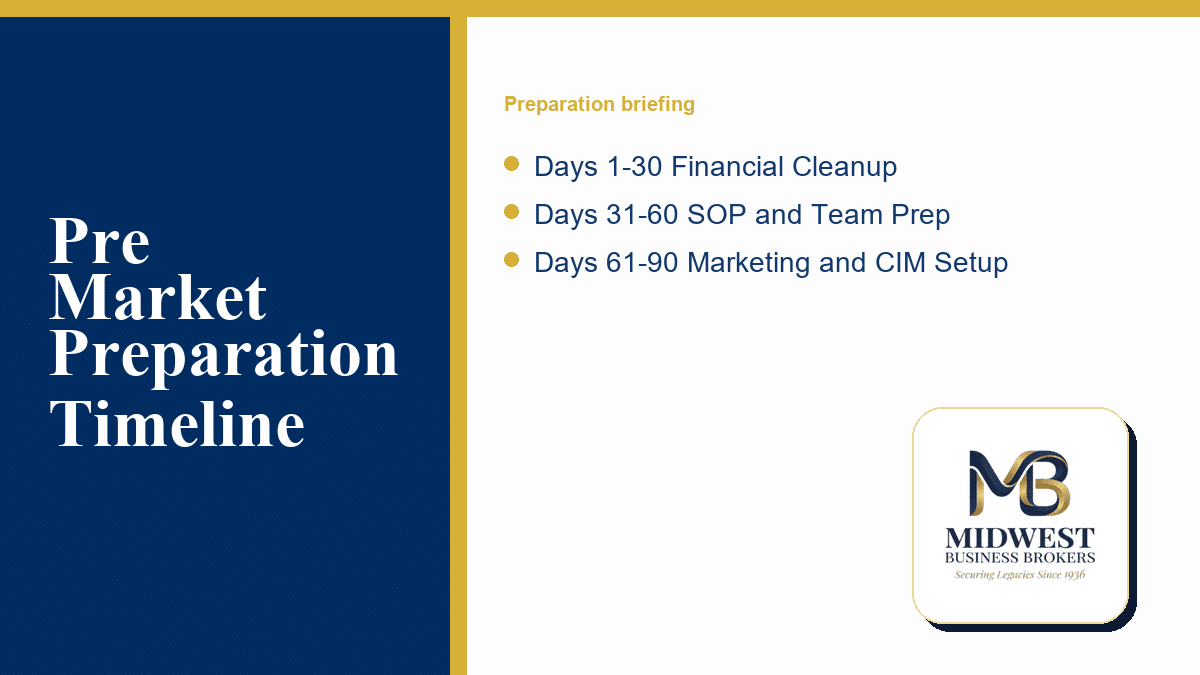
Days 1 to 30: Financial Clean-Up and Valuation Baseline
Focus on reconciliations and establishing a defensible valuation. Work with your accountant to clean up general ledger entries, separate personal expenses from business operations, and obtain a Professional Valuation Assessment. This stage ensures that SDE calculations are supported by verifiable documentation, reducing the risk of a future buyer retrade.
Days 31 to 60: Operational Documentation and Team Prep
Focus on transferability and operational documentation. Write detailed standard operating procedures (SOPs) for key operations, delegate primary client relationships to management, and ensure that lease agreements, equipment titles, and customer contracts are organized and ready for review. This reduces owner dependence and demonstrates operational stability.
Days 61 to 90: Marketing Preparation and Confidentiality Setup
Establish confidentiality controls and draft marketing materials. Prepare the blind profile (teaser) and the Confidential Information Memorandum (CIM). Set up a secure virtual data room (VDR) to hold sensitive due diligence documents. Vetting buyer screening protocols during this phase ensures that only qualified buyers gain access to operational details.
Following this timeline ensures the business is presented to the market in the best possible light. Preparing the business systematically helps owners enter negotiations with confidence, knowing that they can defend their valuation and protect their company from unnecessary operational disruptions.
Securing the Value of Your Life’s Work
Selling a business is often the most significant financial and emotional event of an owner’s life. It represents the realization of decades of hard work, financial risk, and community contribution. Yet, many owners approach the market without the preparation necessary to secure their legacy. Protecting that value requires professional advice, structured preparation, and a commitment to transactional discipline.
Midwest Business Brokers provides local business owners with the advisory services needed to navigate the M&A process. By offering deep market knowledge, rigorous pre-market valuation, and a proven confidentiality protocol, our team helps owners protect their company’s value and secure clean transaction terms. Sellers who benchmark their readiness against real transaction criteria can identify weak points before buyers use those gaps in negotiation.
If you are considering a transition, the most effective step is to begin preparing early. We invite you to Schedule Your Confidential Consultation with our senior M&A partners. We will review your financial records, analyze local buyer trends, and help you construct a customized readiness plan designed to maximize net proceeds while protecting confidentiality.
Ready to Value and Sell Your Business?
Maximize your net proceeds and protect your business from competitors, employees, and customers during the sale process. Partner with Northeast Indiana’s trusted business brokerage team.
Frequently Asked Questions
How long does it take to sell a business in Fort Wayne?
The typical business sale takes six to ten months from the start of marketing to closing the deal. This timeline includes preparing the marketing materials, screening prospective buyers, negotiating the letter of intent, and completing due diligence. Preparing financial records and documentation before going to market can reduce this timeline by several weeks.
What is the difference between SDE and EBITDA?
Seller’s Discretionary Earnings (SDE) calculates the total financial benefit available to a single owner-operator by adding back the owner’s salary and personal expenses. It is typically used for businesses worth under $3 million. EBITDA (Earnings Before Interest, Taxes, Depreciation, and Amortization) measures the business’s operating profitability independent of ownership structure and is used for larger middle-market companies.
How do business brokers maintain confidentiality during the sale?
Brokers protect confidentiality by using blind marketing profiles that describe the business without revealing its name or location. Prospective buyers must be financially vetted and sign a legally binding Non-Disclosure Agreement (NDA) before receiving detailed information, such as the Confidential Information Memorandum (CIM) or access to the virtual data room.
What is a retrade in a business sale?
A retrade occurs when a buyer requests a reduction in the agreed-upon purchase price during due diligence. Retrades are typically triggered when the buyer discovers discrepancies in the financial records, unrecorded liabilities, unsupported add-backs, or operational issues that were not disclosed before the Letter of Intent was signed.
Do I have to pay capital gains taxes on a business sale in Indiana?
Yes, gains from a business sale are subject to federal and state capital gains taxes. The tax rate depends on whether the transaction is structured as an asset sale or a stock sale, and how the purchase price is allocated across the assets. Working with a CPA and M&A advisor is essential to structure the deal in a way that minimizes the tax burden.
 English
  Español de México
  简体中文
简体中文