
SDE and EBITDA are different ways to describe earnings; neither one alone determines a business’s value, a buyer’s financing, or a sale price. The right comparison depends on the owner’s role, the work that must continue after a sale, the records, and the buyer’s operating plan. Treat each measure as a starting point for analysis, not a valuation conclusion.
Confusion often starts when an earnings figure is quoted without defining what it includes. A buyer, lender, or accountant may analyze the same records using different assumptions about owner compensation, continuing costs, and adjustments. Make those assumptions explicit so a seller can compare like with like rather than treating a shorthand multiple as a promise.
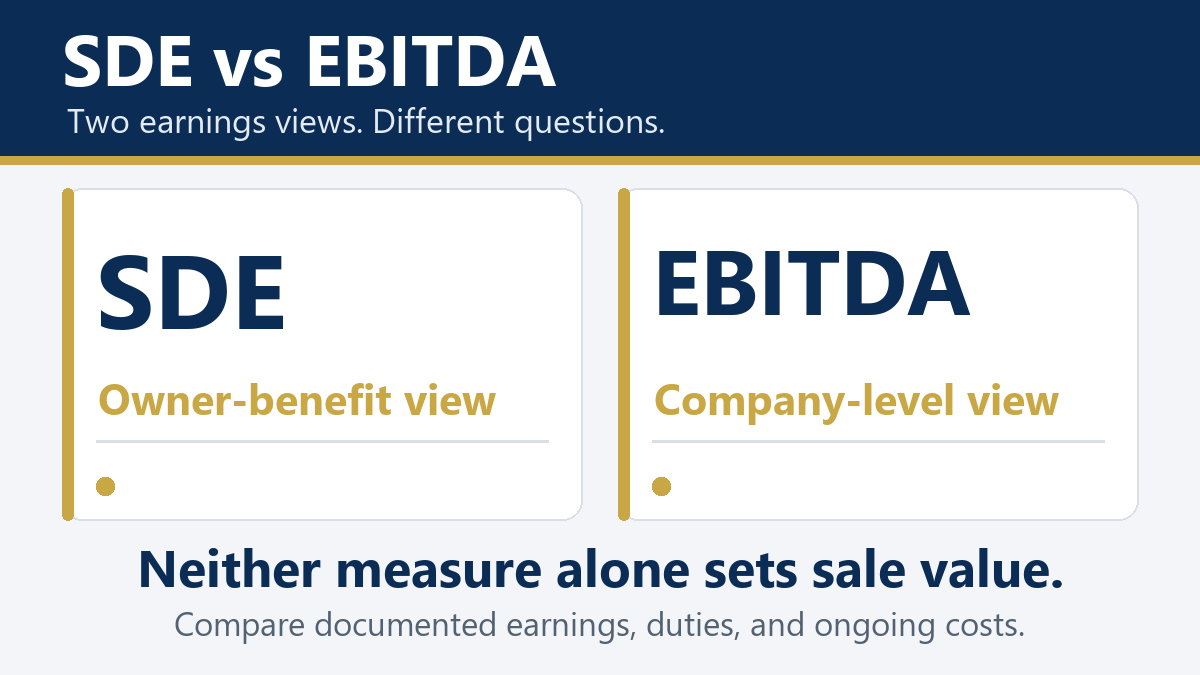
SDE can help explain the earnings benefit associated with one working owner; EBITDA can help describe company-level operating earnings. Neither measure determines which buyer will appear, whether financing is available, or what a buyer will pay. For separate context on cuánto valen los negocios en Indiana por industria y how valuation multiples change by industry, see the existing guides; estimates still require business-specific evidence.
Qué es SDE y quién lo utiliza
Seller’s Discretionary Earnings (SDE) is a measure often used to discuss the earnings benefit associated with one working owner. Definitions vary, so state the calculation basis. An analysis may consider owner compensation and benefits, interest, taxes, depreciation and amortization, and documented discretionary or non-recurring items where appropriate. Which adjustments are supportable depends on records, the owner’s duties, and costs a buyer would need to replace; no expense qualifies merely because it is labeled an add-back.
SDE can be useful when considering a hands-on ownership scenario and the earnings associated with the owner’s work. Its relevance depends on the business, management structure, owner responsibilities, and buyer’s plan. There is no universal purchase-price cutoff established here, and SDE should not be presented as cash available after debt service, taxes, investment, or other buyer costs.
The following is a hypothetical arithmetic illustration, not a real Indiana business, tax return, transaction, or accepted adjustment. Assume only for illustration that reported net income is $85,000, owner compensation is $120,000, documented owner benefits total $40,000, and a $10,000 non-recurring item is supported. Whether an item qualifies for an adjustment must be evaluated from the underlying records. Under those assumed inputs, the arithmetic is:
$85,000 ingresos netos
+ $120,000 salario del propietario
+ $15,000 seguro de salud del propietario
+ $25,000 vehículo personal
+ $10,000 gasto legal único
= $255,000 SDE
The resulting $255,000 is an illustrative earnings bridge only. It is not a validated SDE figure, a lender’s underwriting result, a buyer’s offer, or an estimate of sale value. The treatment of each item may change after review of records, ongoing costs, owner duties, and required replacement labor. No sale multiple is applied in this example.
SDE can make an owner-operator scenario easier to discuss, but the result depends on a consistent definition and documented adjustments. Owner-specific or non-recurring costs should be explained and supported; recurring or necessary operating costs may remain in the analysis. A label alone does not make an expense an add-back.
Qué es EBITDA y quién lo utiliza
EBITDA means earnings before interest, taxes, depreciation, and amortization. It is one way to describe company-level operating earnings before those items, but a normalized analysis still needs clear definitions and support for adjustments. If the owner performs work needed to operate the business, consider what compensation or management coverage may be required after a sale rather than automatically treating all owner pay as removable.
EBITDA may be useful when a business is assessed as an operating company, particularly when its management and reporting help explain results apart from one owner’s daily work. SDE may remain relevant when a buyer expects to take on an active owner role. Purchase price alone does not create a fixed switch point; the comparison depends on duties, organization, records, and the intended operating model.
Different buyers may evaluate earnings and operating needs differently. A buyer expecting an existing team to continue may focus on company-level results; a hands-on buyer may need to understand the time, responsibilities, and earnings associated with one working owner. These are possible analytical scenarios, not statements about the prevalence or behavior of a buyer class. Identify who will perform each necessary job and reflect related costs in the analysis.
Consider a hypothetical business with a general manager and staff expected to remain after ownership changes. An EBITDA analysis would need to account for ongoing operating costs and any compensation needed to keep the business functioning. Do not subtract seller pay or a one-time expense without checking what the buyer must replace and what the records support; a complete earnings bridge requires the underlying documents.
There is no single multiple in this article that can be applied across SDE- and EBITDA-based analyses. A multiple, when appropriate, depends on relevant comparable evidence and business-specific facts. A higher multiple applied to a different earnings base does not automatically mean a higher value; compare consistent definitions before drawing a conclusion.
When Earnings Measures Affect Comparisons
Using an earnings measure that does not fit the buyer’s operating plan can make financial comparisons confusing and introduce assumptions that may not hold during review. Before presenting SDE or EBITDA, explain what is included, how owner duties are treated, which adjustments are supported, and what work may need replacement after closing.
For example, an owner may add compensation back when presenting an owner-benefit view. If a buyer expects the company to keep paying someone to perform the same work, that continuing cost belongs in the buyer’s analysis. The parties may therefore be discussing different earnings measures rather than disagreeing about the same number; show the definition and support for each adjustment.
In another hypothetical, a buyer who expects to take on daily operating responsibilities may want to understand the earnings associated with that role, while a buyer retaining management may focus on company-level results. Which view is useful depends on the buyer’s actual plan and the records. Financing is a separate decision and should not be assumed from the earnings measure.
Some businesses can be evaluated under both measures, particularly when owner responsibilities, management continuity, and buyer plans need to be modeled separately. The analysis should explain why each measure is being shown and what costs or adjustments differ. This is not a claim that a particular transaction size or value range always belongs to one metric.
A hypothetical company may show one owner-benefit figure and a different company-level operating figure after accounting for the cost of management. Both figures should come from the same documented records, be clearly labeled, and reconcile line by line. Without that bridge, comparing headline numbers or applying a generic multiple is not reliable.
The two measures can answer different questions and are not interchangeable. A buyer’s view depends on the work they will take on, the team and costs that will remain, the earnings record, and the transaction structure. A buyer type or financing source does not by itself settle the appropriate calculation.
There is no universal answer to which number is right. Explain the business’s current owner role, responsibilities that must continue, documented adjustments, and the buyer scenario being considered. Separate historical earnings, any normalized presentation, and possible buyer-specific synergies rather than treating them as interchangeable measures.
Clarity at the outset can reduce confusion when financial statements are reviewed. Present supported assumptions, distinguish recurring from non-recurring items, and avoid presenting one measure as though it proves the outcome under another buyer’s operating plan. Any conclusion depends on transaction-specific evidence.
How to Match the Metric to the Buyer
Market surveys provide context, not an individual valuation rule. The IBBA/M&A Source Q2 2026 Market Pulse highlights report SDE-multiple segments for transactions below $2 million in purchase price and EBITDA-multiple segments for transactions from $2 million to $50 million. These are national survey-reporting categories, not Indiana-specific multiples, universal metric cutoffs, or instructions for a buyer or lender.
The SBA lists complete or partial changes of ownership among eligible uses for its 7(a) program, subject to current program terms and lender review. That is an eligible-use category; it does not establish how common SBA financing is for Indiana acquisitions or guarantee approval. Review the official SBA 7(a) program guidance and discuss current requirements with a qualified lender.
In some transactions, a buyer may review both owner-level earnings and company-level earnings: first to understand the seller’s current role and then to model ongoing management needs. This is a possible analytical approach, not a claim about typical search-fund or buyer behavior in any Indiana market. Each calculation should be supported by the records, duties, and proposed operating plan.
A buyer may model transaction-specific synergies, such as combining systems or overlapping overhead. Those potential benefits depend on that buyer’s situation and should not be presented as guaranteed value or as a general valuation rule. The business’s standalone earnings remain a separate analysis.
For a seller, practical preparation begins with current financial statements and tax records, a clear account of owner duties, an organization chart, and documents supporting proposed adjustments. These materials can help an advisor model the earnings views that fit a potential buyer without presuming which buyer or financing source will determine value.
Before deciding which measure to emphasize, review the company’s operating model and earnings records. Read la guía completa de valoración de Indiana for broader seller-side context; no guide or formula replaces a business-specific review of verified financials, owner duties, and buyer needs.
Common Add-Back Issues to Review
SDE and EBITDA both depend on consistent definitions and support for adjustments. Organize records for each proposed item and explain why it is not expected to recur or why an owner-specific cost differs from what a buyer would need. Treatment can vary by transaction and should be reviewed with appropriate accounting and transaction professionals.
Potential adjustments may include documented owner compensation, owner-specific benefits, or a non-recurring expense, but none qualifies automatically. Explain the amount, business purpose, supporting records, the owner’s role, and whether a buyer would incur a replacement or continuing cost. If rent or related-party expenses are involved, document the arrangement and any comparison used; do not assume a particular adjustment will be accepted.
Items that deserve careful scrutiny include expenses without a clear business purpose or supporting records, recurring costs described as one-time, and costs that a buyer will still need to incur. An adjustment should not be presented as established merely because the owner considers it personal, unusual, or discretionary. Buyers and their advisers may reach a different conclusion after reviewing the documentation.
There is no reliable thirty-second test for every adjustment. A reviewer needs enough documentation to understand the item, its business purpose, whether it is recurring, and whether the buyer must replace the underlying work or expense. Keep invoices, payroll and tax records, contracts, and a concise explanation; unsupported amounts should be identified as uncertain rather than promised.
As a hypothetical, an owner may propose several adjustments but have records supporting only some of them. The analysis should list each item separately, show the evidence and calculation, and distinguish accepted, disputed, and unverified amounts. Do not turn an unsupported adjustment into a projected loss of sale value by multiplying it by a generic multiple.
Tax treatment is outside this SDE-versus-EBITDA comparison and may change over time. Ask a qualified tax professional to review the relevant tax records and explain any tax-related adjustments; do not rely on an older state-rate summary as a substitute for current advice.
Referencia rápida de SDE vs. EBITDA
Primary lens
SDE: Earnings associated with one working-owner scenario
EBITDA: Company-level operating earnings before interest, taxes, depreciation, and amortization
Owner compensation
SDE: May be considered in an owner-benefit view; support the amount and owner’s role
EBITDA: Consider compensation for management work the business needs after a sale
Potential use
SDE: May help analyze a hands-on buyer scenario
EBITDA: May help analyze an operating-company scenario
Size cutoff
SDE: No universal cutoff established here
EBITDA: No universal cutoff established here
Financiamiento
SDE: Depends on buyer, business, transaction, and lender
EBITDA: Depends on buyer, business, transaction, and lender
Valuation conclusion
SDE: The measure alone does not set a value or multiple
EBITDA: The measure alone does not set a value or multiple
The table is a comparison, not a shortcut. Do not apply a multiple from one earnings measure to another or treat a buyer’s screening metric as a value conclusion. Verify the earnings definition, owner role, required replacement management, and supporting records before discussing value.
Cuándo cambiar de SDE a EBITDA
Revenue alone does not determine which earnings view is most useful. Consider whether the business can operate with its current team, which responsibilities remain with the owner, and what labor or management a buyer may need to replace. Those facts—not a fixed revenue or purchase-price threshold—help frame the comparison.
Owners preparing for a sale can document procedures, delegate responsibilities where practical, and reduce dependence on undocumented individual relationships. These steps may help explain how operations continue, but they do not guarantee a broader buyer pool, a premium, or a particular valuation. Any effect should be demonstrated with business records and buyer feedback.
Esa es la secuencia que importa. No se trata de volver a etiquetar la hoja de cálculo. Cambiar el negocio para que la hoja de cálculo cuente una verdad diferente.
Qué hacer antes de salir al mercado
If you are considering a sale, discuss the earnings basis before marketing materials are prepared. Identify the buyer scenario being evaluated, how the owner’s work is handled, and what management or costs must continue. Use the resulting financial presentation to explain assumptions rather than to promise a particular buyer or outcome.
A pre-sale review can clarify three practical questions: which earnings measure best describes the business for the intended analysis, which adjustments are supported by records, and what operating responsibilities a buyer would need to continue or replace. The answers depend on the company’s facts and should be documented before a buyer evaluates the opportunity.
- Evaluación Profesional de Valoración - Obtenga una visión centrada en la transacción sobre si su negocio debe valorarse en SDE, EBITDA o ambos, y qué adiciones realmente resistirán el escrutinio.
- Programa tu consulta confidencial - Revise sus números, grupo de compradores y estructura de transición con un asesor que trabaje en negocios de Indiana en el rango de $1 millón a $10 millones.
For a plain-English introduction, read Midwest’s SDE meaning in business valuation guide, then use this comparison to consider how owner responsibilities and management needs affect the earnings view. Neither article is an appraisal or a substitute for reviewing a company’s records.
Preguntas Frecuentes
¿Cuál es la diferencia entre SDE y EBITDA?
SDE and EBITDA describe different earnings views and are not interchangeable. SDE may include adjustments for one working owner’s compensation and specific owner benefits. EBITDA measures earnings before interest, taxes, depreciation, and amortization; a normalized company-level view must still account for operating costs and management needed after a sale. State the definitions used and support each adjustment.
¿Qué métrica debo usar para valorar mi negocio en Indiana?
There is no universal dollar cutoff. A hands-on owner-operator scenario may call for an SDE analysis; a company-level assessment may use EBITDA, depending on management depth, owner responsibilities, the buyer’s plan, records, and replacement compensation. Do not select a metric based on size alone.
¿Por qué SDE da un número más alto que EBITDA?
SDE may exceed EBITDA when it includes owner compensation or benefits that are not included in the EBITDA presentation, but that is not automatic. The result depends on definitions and the treatment of management and other costs. A higher earnings figure does not by itself imply a higher business value; any valuation must use a supported, comparable basis.
¿Qué múltiplo de SDE es típico para las empresas de Indiana?
There is no single SDE multiple that applies to every Indiana business. The national IBBA/M&A Source Q2 2026 Market Pulse segments described above are survey-reporting categories, not Indiana-specific valuation ranges or fixed metric boundaries. A business-specific analysis needs relevant transaction evidence and review of industry, earnings quality, owner duties, management, deal terms, and other facts.
¿Puedo cambiar de SDE a EBITDA para obtener una valoración más alta?
Do not switch metrics simply to produce a larger headline number. Compare the business’s current operating model with the work and costs a buyer would need to replace, and show the assumptions behind each view. Better delegation, records, and documented processes may help explain transferability, but do not guarantee a particular buyer, price, or outcome.
 English
  Español de México
  简体中文
简体中文