
大多数行业的商业估值倍数表是为了快速浏览而设计的,而不是用于实际使用。它们告诉印第安纳州的业主,制造业的交易范围是一个,暖通空调是另一个,科技是第三个。它们遗漏的是实际上改变价格的部分:买家是谁,交易如何融资,业主离开时现金流有多少存活,以及买方尽职调查在第一份保密协议后等待着多少。.
In Indiana’s lower middle market, a multiple is not a trophy. It is a shorthand expression of transfer risk. A premium EBITDA multiple can look reasonable in an Indianapolis confidential information memorandum (CIM) and still collapse in diligence if the business has weak management depth, thin contracts, unproven add-backs, or lender-sensitive cash flow. Owners who rely on broad national averages usually anchor to the wrong number before the process starts.
This reference uses a limited set of reported U.S. platform figures only as context, alongside discussion of buyer, earnings-measure, and transfer risks; it is not an Indiana-specific sold-company data study. For the broader process around timing, positioning, and buyer sequencing, read the 2026终极卖方指南. To discuss an owner-specific range and its assumptions, start with a 专业评估.

Reported Industry Multiples: U.S. Reference Points, Not Indiana Valuations
A multiple is useful only when the earnings measure, buyer profile, and transaction terms are clear. The selected reference points below summarize reported U.S. sales from Q3 2021 through Q2 2026 using cash-flow/SDE figures reported by owners or brokers. They are not Indiana-specific transaction ranges, and the public industry table does not show sample counts by industry. Its dataset-wide median reported sale price is $340,000; treat these figures as broad context, not a price target or a value for a specific company. A separate U.S. Q2 2026 market snapshot reported 2,117 completed sales, down 10% year over year, a 2.7x average cash-flow multiple, and a $349,250 median sale price. These platform-level figures are not Indiana transaction results or a company-specific valuation. Source: BizBuySell Q2 2026 Insight Report, reviewed September 23, 2026.
这里是业主错误使用倍数的快速方式:他们拉取他们能找到的最高范围,将其应用于一个松散调整的收益数字,然后称结果为价值。严肃的买家则相反。他们首先对收益进行压力测试,剔除不支持的调整,规范业主补偿,建模过渡成本,然后决定风险概况可以证明的倍数。倍数是方程的最后一部分,而不是第一部分.
That matters because buyers are selective. Sophisticated buyers may test earnings, working capital, and financing assumptions during diligence. If you quote a premium multiple without premium documentation, you are just giving the buyer a future re-trade target.
On a phone, swipe inside the table to see all columns.
| Industry or business type | Average reported cash-flow/SDE multiple | Median sale price |
|---|---|---|
| 暖通空调企业 | 2.83x | $750,000 |
| 管道企业 | 2.61x | $699,000 |
| Electrical and mechanical contracting businesses | 2.77x | $1,009,000 |
| Landscaping and yard-service businesses | 2.49x | $449,950 |
| Manufacturing sector average | 3.04x | $726,914 |
| Metal-product manufacturers | 3.27x | $1,253,099 |
| Machine shops and tool manufacturers | 3.51x | $900,000 |
| 会计和税务实践 | 2.27倍 | $450,000 |
| 货运公司 | 3.00x | $1,100,000 |
| Durable-goods wholesalers and distributors | 3.05x | $840,000 |
| Nondurable-goods wholesalers and distributors | 2.89x | $750,000 |
How to read this: these are averages, not a low-to-high range, asking-price targets, or forecasts for Indiana. A listed median sale price is not a business valuation. The reported cash-flow multiple is not an EBITDA multiple. Business-specific financial records and comparable transactions are needed to interpret any reference point.
The Q2 2026 IBBA/M&A Source Market Pulse reports SDE-based multiples for purchase-price segments below $2 million and EBITDA-based multiples for segments from $2 million to $50 million. That is a reporting convention for its market segments, not a universal rule for choosing a metric. Read the official Q2 2026 Market Pulse highlights.
Professional-services owners using the matrix should also review the guide to preparing an Indiana CPA firm for sale, where client retention, realization rates, partner dependence, and transition terms become part of the buyer’s underwriting.
Understanding the Valuation Denominator: SDE vs EBITDA
A common source of confusion is applying a multiple to the wrong or undefined earnings measure. Industry shorthand is difficult to compare unless you know whether it refers to SDE, EBITDA, collections, or gross billings. State the earnings denominator and normalization assumptions before comparing a reported multiple.
When Buyers Analyze Owner-Operated Firms on SDE
SDE is often useful when the likely buyer expects to take an active owner-operator role. The measure commonly includes the economic benefit of one working owner’s compensation and benefits, but the exact earnings base and adjustments must be defined and supported. An industry label alone does not determine the right metric.
For a management-run company, an EBITDA analysis may be more relevant if it reflects the operating costs that continue after a sale. If an owner currently fills a necessary role, a buyer may consider a supported replacement-management cost. The same business may be assessed on different bases by different buyers; compare each clearly defined earnings measure with the role and operating plan it assumes.
When an EBITDA Analysis May Fit
EBITDA may fit a transaction where the buyer expects the business to operate with ongoing management and the earnings measure accounts for those management costs. Likely buyer, size, management depth, owner duties, and operating model matter; no sector list automatically determines the metric.
A single company may attract owner-operator, strategic, or financial buyers and be examined on different earnings bases. For example, a trade contractor with management depth may be modeled differently from one whose owner performs most billable and supervisory work. State the metric, the owner’s post-close role, and any replacement-management assumption. Comparing an EBITDA multiple with an SDE figure without labeling the earnings basis can be misleading; if the likely buyer must replace the owner’s operating duties, that cost may affect the earnings available to that buyer. For a deeper comparison, read the SDE与EBITDA的解释.
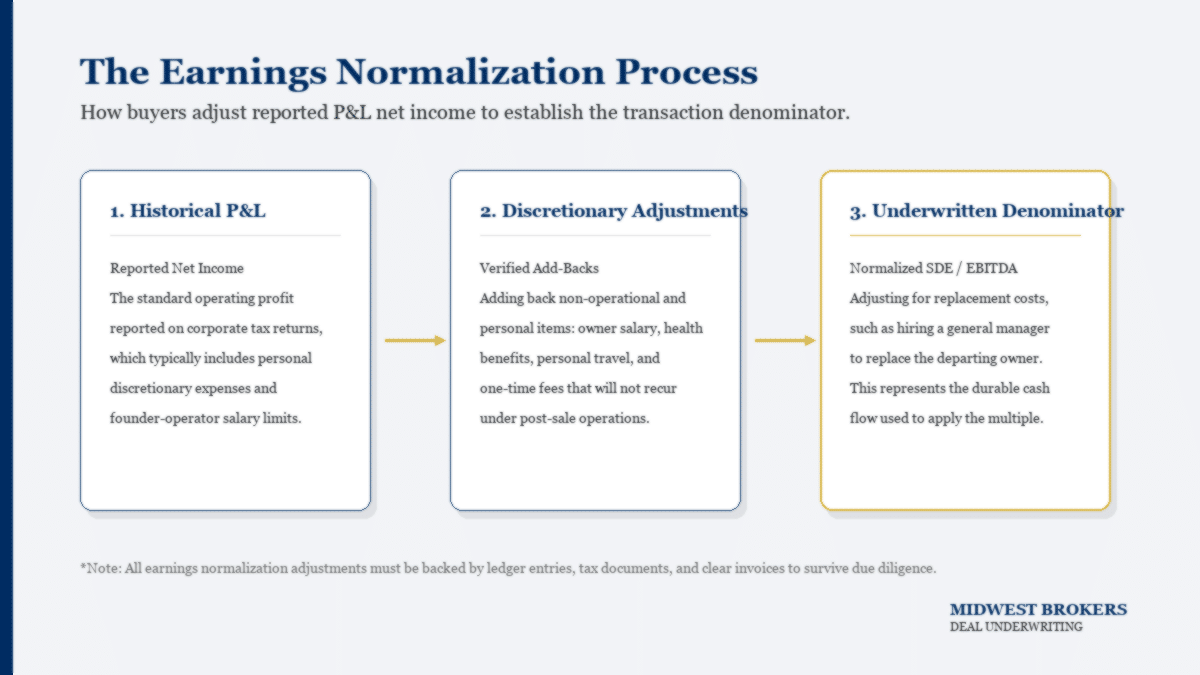
The Science of Earnings Normalization and Add-Backs
Earnings normalization starts with reported records and evaluates recurring operations for a clearly stated measure. It is not a list of automatic add-backs or a promise of proceeds. The treatment of owner compensation, benefits, interest, taxes, depreciation, amortization, and other items depends on whether the analysis is SDE or EBITDA and on the transaction facts.
Support each proposed adjustment with relevant ledger, tax, payroll, invoice, contract, or other records and explain why it is nonrecurring or unnecessary after closing. A working owner’s compensation may be treated differently in an SDE view than the cost of management needed in an EBITDA view. Buyers, lenders, and quality-of-earnings reviewers may evaluate evidence differently; no particular adjustment is automatic or guaranteed to be accepted.
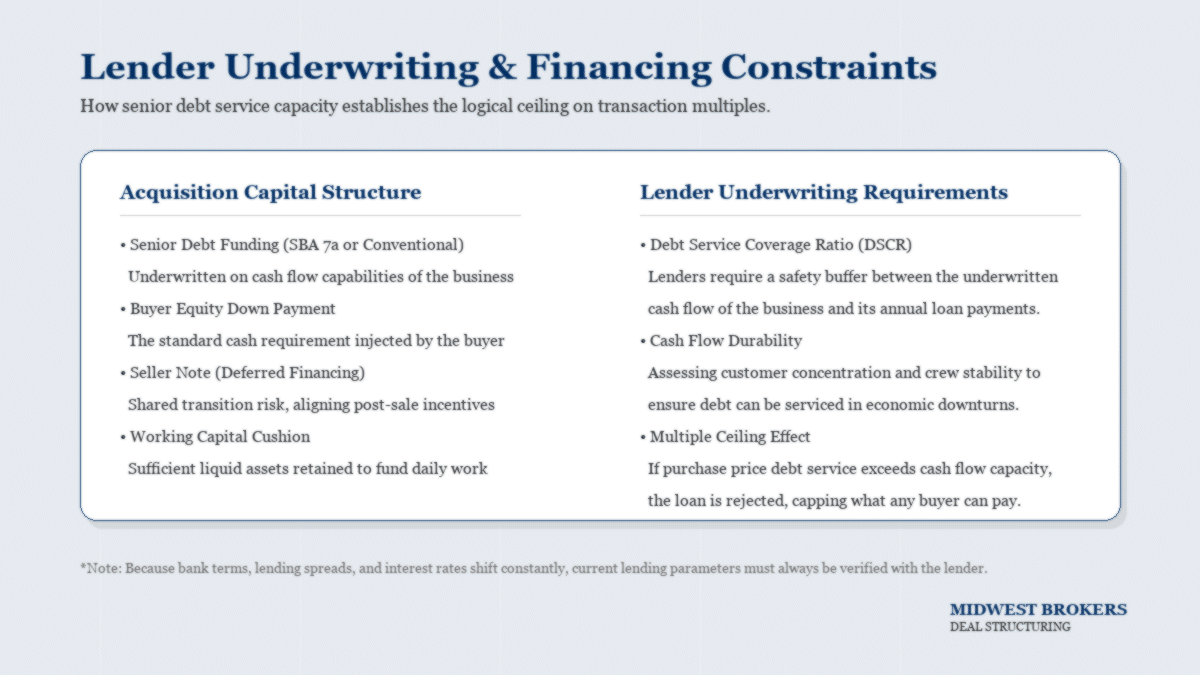
How Acquisition Financing Can Affect a Buyer’s Offer
Financing can affect what a financing-dependent buyer can support, but SBA policy does not create a universal industry-multiple ceiling. A lender may assess eligibility, buyer equity, loan structure, debt-service capacity, working-capital needs, and supporting records under the rules then in effect; criteria vary by lender and transaction. Confirm current program details with a lender and the official SBA 7(a) loan guide.
A lender may analyze repayment capacity using projected cash flow and debt service, including a debt-service coverage measure where applicable. The method and requirements depend on the program, lender, and transaction. This article does not determine whether a particular buyer will qualify or a loan will be approved.
Unsupported earnings adjustments, required owner replacement, capital spending, and working-capital assumptions can affect a financing-dependent buyer’s underwritten cash flow and offer. The effect is transaction-specific; it does not mechanically determine an industry multiple or guarantee loan approval.
Indiana Industry Analysis: Regional Density and Sector Drivers
Local labor, customer and supplier concentration, facility needs, and access to buyers may matter in diligence. This article does not present Indiana sector-by-sector closed-sale samples, so the following are questions to investigate—not measured evidence of an Indiana industry premium or discount.
Manufacturing and Industrial Density
For a manufacturing company, investigate customer and supplier concentration, labor availability, facility and equipment condition, maintenance capital needs, management depth, and access to relevant buyers. Evidence about these factors may shape diligence, future investment, and negotiations; it does not establish a measured Indiana multiple. Capital expenditures are not a mechanical reduction to the EBITDA denominator, though buyers may consider expected maintenance or replacement investment when assessing future cash needs and offer terms. Support the discussion with equipment, maintenance, and capital-spending records. For a deeper look at plant valuation questions, read 制造业估值. Fort Wayne owners can also use our local valuation-preparation resource to organize equipment, lease, and management records before relying on a multiple.
HVAC, Plumbing, and Licensed Trade Services
Service businesses are where owners most often confuse top-line revenue with enterprise value. Key considerations for owners in these sectors include local market demand, licensing transferability, route density, and workforce stability. For HVAC businesses, valuation drivers include the density of maintenance agreements and technician retention. If you want the full mechanics behind these factors, our HVAC估值指南 breaks out how agreement mix and technician retention affect the valuation. For plumbing and electrical contracting, the ease of license transferability is a primary operational consideration. See our 管道估值指南 和我们的 电气承包商估值 guide for details on crew licensing requirements. Landscaping and lawn care businesses are similarly driven by route density and seasonal contract structures, where stable crews and auto-renewing commercial contracts support valuation stability. Owners moving from a plumbing valuation question toward an exit can also review the Indiana plumbing business seller guide for sale-specific preparation and sequencing.
For owners moving from valuation planning toward a potential sale, the HVAC seller preparation guide explains the records, staffing dependencies, and buyer-readiness questions to review before outreach.
Professional and CPA Practices
Professional services demonstrate how the choice of valuation metric depends on the transaction context. An owner must assess buyer profile, operating model, and transfer risk to determine whether SDE, EBITDA, collections, or another metric is appropriate. For smaller practices, buyers are often acquiring recurring client relationships, which may lead to valuations based on a percentage of collections or billings, whereas larger firms with institutional structures typically use an EBITDA framework. Client retention, realization rates, and partner dependence are key drivers. If a departing partner holds all primary client relationships, the value compresses due to transfer risk. We analyze these variables in our 会计事务所估值 guide. Similarly, medical and dental practices may be assessed on collections or EBITDA depending on provider independence and operational structure.
Logistics, Wholesale, and Distribution
For distribution and logistics companies, access to transportation infrastructure, regional customer demand, and labor availability are key factors owners should assess. Valuation metrics and risk profiles vary significantly depending on the operating model. Asset-light operations like third-party logistics (3PL) providers and freight brokers carry different capital expenditure profiles compared to asset-heavy trucking fleets. Trucking companies are heavily influenced by equipment age, driver retention, and safety metrics. Wholesale distributors focus on inventory turns, warehouse automation, and customer concentration. For a detailed breakdown of these distinct structures, review our 物流估值指南 和我们的 卡车公司估值 指南中涵盖了这一框架。.
Commercial Construction and Contracting
The parties may negotiate a working-capital target or peg during diligence. The included accounts, calculation method, treatment of receivables and retainage, and any closing true-up depend on the transaction documents; there is no automatic dollar-for-dollar adjustment across all deals. Bonding continuity, guarantees, and working-capital needs may require separate planning.
Specialty Retail and Food Service
A smaller owner-operated restaurant may be examined on SDE if the buyer expects to take an active operating role; a management-run group may support an EBITDA analysis if ongoing management costs are reflected. Business size and sector alone do not settle the metric. Lease terms, inventory, staff, licenses, and operating continuity remain transaction-specific diligence questions. If you are preparing a food-service business for sale, review the existing 餐厅退出问题.
Why the Multiple is Only Part of the Transaction Story
Enterprise value is not the same as net proceeds or cash received at closing. Offer structure, debt, working capital, fees, taxes, escrow or holdbacks, and deferred consideration can matter. The letter of intent and signed purchase agreement define the transaction terms; qualified financial, tax, and legal advisers should review their implications.
Many transactions are negotiated on a cash-free/debt-free or similar basis, but the offer and purchase agreement define included cash, debt-like items, assets delivered, and payoff mechanics. Parties may agree on a normal working-capital level; its target, included accounts, exclusions, and any true-up are negotiated and defined in the documents. A shortfall does not create one universal dollar-for-dollar adjustment.
Fees and transaction expenses reduce net proceeds, while tax results depend on legal structure, asset allocation, basis, jurisdiction, and other facts. An asset-versus-equity label alone does not determine a seller’s tax result. Ask a qualified CPA or tax and legal adviser to model the specific transaction. A seller note or earnout can defer proceeds and add collection or performance risk. Compare payment timing, security and subordination, conditions, measurement terms, setoff rights, and the seller’s post-close role where applicable. A headline multiple alone is not enough to compare offers.
An Owner’s Guide to Building a Defensible Valuation Range
To defend your valuation when a buyer’s QofE firm starts underwriting, you must be prepared. Do not rely on industry rules of thumb or simple shortcuts. As noted in our related analysis on rule of thumb business valuation models, shortcuts are useful starting benchmarks but can fail to survive diligence when specific risk factors are uncovered.
A useful valuation discussion starts with organized records and stated assumptions. Reconcile financial statements to tax returns and explain differences; identify owner duties, customer concentration, contract terms, capital needs, and management continuity; and compare the business with relevant evidence on a clearly defined earnings basis. CPA review, quality-of-earnings work, written agreements, and lender modeling may be appropriate in some cases but are not universal prerequisites. Good preparation can support a better-informed discussion and reduce avoidable uncertainty, but it cannot guarantee buyer interest, lender approval, a sale price, or a closing; offers and terms may change as diligence develops.
Business Exit Readiness Checklist
- Reconcile available tax returns and financial statements; document and explain material differences.
- List proposed adjustments and connect each to ledger, payroll, tax, invoice, or other supporting records; distinguish SDE from EBITDA treatment.
- Inventory material equipment and available maintenance or capital-spending records; obtain a specialist valuation only when it is useful for the decision.
- Identify important customer and supplier agreements and review renewal, assignment, notice, and change-of-control terms; do not assume transferability.
- List material licenses and permits and verify renewal, transfer, consent, or reapplication requirements with the issuer or a qualified adviser.
- Map owner-dependent duties and key personnel; consider transition, retention, and continuity questions where relevant.
- Prepare an illustrative proceeds model using deal terms, debt, working capital, fees, taxes, and any deferred payments with qualified financial and tax advice.
Prepare Your Valuation Strategy Before Testing the Market
Whether a sale is near-term or still exploratory, timing depends on the owner’s goals, the business, buyer readiness, and transaction facts; there is no single preparation window that fits every company. Pair this reference with the 2026 ultimate seller guide to understand the general sale process.
For information about the existing 专业评估 offering, review the linked service details; it does not guarantee what a specific buyer or lender will support, a sale price, or a closing. If you are ready to discuss your situation, 安排您的保密咨询 with a Midwest Brokers advisor. Tax and legal advice belongs with qualified advisers.
Industry multiples are a reference point, not a substitute for choosing and applying the right approach. Owners comparing the income, market, and asset approaches can review Midwest’s business valuation methods and formulas before treating any sector multiple as a conclusion.
Frequently Asked Questions Regarding Business Multiples
2026年各行业典型的SDE倍数是多少?
The table above shows selected averages from reported U.S. sales through Q2 2026, not Indiana-specific ranges or a prediction for an individual business. The right comparison depends on verified normalized SDE or EBITDA, likely buyer, transferability, and deal terms. A business-specific analysis is needed before using a multiple to set expectations.
EBITDA倍数在各州之间是否有所不同,还是全国统一?
The cited table reports U.S. platform data and does not measure an Indiana-versus-other-state premium. Local labor, customer or supplier concentration, buyer access, and financing conditions may affect diligence and negotiations, but the figures here do not quantify those effects. Compare businesses on a clearly stated earnings basis and transaction terms before drawing a geographic conclusion.
What factors drive the strongest valuation multiples?
No single factor assures a higher multiple. Buyers may evaluate the durability of earnings, management continuity, customer concentration, contract transferability, capital needs, and owner dependence. The weight assigned to each depends on the buyer, financing, and business. These are diligence considerations, not a formula or a promise of premium terms.
我怎么知道我应该为我的业务使用SDE还是EBITDA?
Choose the measure based on the likely buyer and the work the owner performs, not the industry label alone. SDE commonly accounts for one active owner’s compensation and benefits. EBITDA analysis can require a supported adjustment for management costs that continue after closing. The same company may be evaluated on different measures by different buyers, so compare earnings on a clearly stated and supported basis.
为什么两家收入相同的企业会以不同的价格出售?
Revenue can be one reference point in some sectors or transactions, but it does not tell the full story. Two companies with the same sales may have different margins, verified earnings, customer concentration, contract durability, capital needs, staffing, working capital, and owner dependence. The relevant valuation measure and deal terms depend on the business and likely buyer; similar revenue alone does not establish similar value or net proceeds.
 English
  Español de México
  简体中文
简体中文